
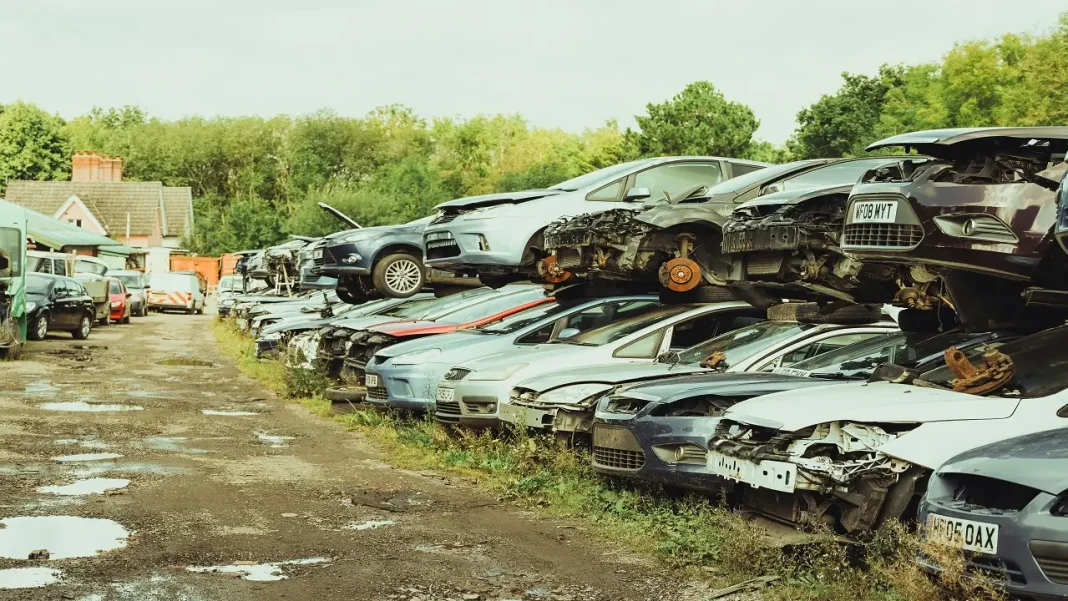

Handing an old car to a scrap dealer does not automatically qualify you for new-vehicle benefits. Under vehicle scrapping rules in India, the Certificate of Deposit, or CoD, must come through a Registered Vehicle Scrapping Facility (RVSF).
That certificate opens the route to eligible concessions. The scrap payment, registration-fee waiver, and road-tax relief are separate amounts, and the final saving depends on the applicable rules.
Key Highlights
- Apply through V-Scrap and use a registered facility.
- A CoD acknowledges vehicle submission; the scrapping certificate follows dismantling.
- State tax concessions and manufacturer offers need separate confirmation.
How to Get a Certificate of Deposit
Start at the official V-Scrap portal. The NIC user manual allows applications to a selected RVSF or bids from multiple facilities, giving owners a way to compare scrap offers.
Have the paperwork ready:
- Original registration certificate, owner identification, and address proof.
- PAN details and a cancelled cheque for the owner’s bank account.
- Authority documents if a representative is handing over the vehicle.
The application follows Form 2. The facility verifies ownership and checks the vehicle record, including finance-related restrictions and outstanding dues. Resolve these before arranging collection; submitting an online form does not complete the handover.
Once the vehicle is accepted under the prescribed process, the RVSF pays the agreed consideration and issues the digitally signed CoD through VAHAN. Keep the payment receipt and confirm the certificate’s vehicle and owner details.
The Certificate of Vehicle Scrapping (CVS) arrives after dismantling and treatment. Ask for that record too, and confirm cancellation of the old registration. A scrap-payment receipt alone should not be treated as proof that every registration step is finished.
New-Vehicle Benefits and Their Limits
MoRTH’s 25 March 2026 parliamentary reply identifies registration-fee relief and motor vehicle tax concessions against a CoD.
| Benefit | What the Rules Provide | What to Confirm |
| Registration certificate fee | Waiver when the new vehicle is registered against a CoD | The fee is removed from the registration calculation |
| Standard motor vehicle tax concession | Up to 25% for non-transport vehicles; up to 15% for transport vehicles | State notification, category and applicable limits |
| Specified older emission categories | Up to 50% motor vehicle tax concession under G.S.R. 200(E), dated 26 March 2025 | The scrapped vehicle’s category and emission standard qualify |
| Manufacturer discount | Separate from statutory fee and tax relief | A current written offer for the chosen model |
The 50% provision covers BS-I and earlier transport and non-transport vehicles, plus BS-II medium and heavy goods and passenger vehicles. It is not a blanket 50% discount on a new car.
The percentage applies to eligible tax, not the vehicle’s purchase price. Hypothetically, a 25% concession on ₹80,000 tax saves ₹20,000. That calculation assumes the full rate applies without a lower state cap.
Claim the CoD Before the New Vehicle Is Registered
Give the dealership the certificate before it submits the registration application. The rules require digital verification by the registering authority or dealer; after utilisation, the CoD is marked cancelled in VAHAN.
Ask for an itemised calculation:
- Show the registration-certificate fee waiver separately from motor vehicle tax.
- Identify the state notification behind the tax concession and list any manufacturer discount separately.
A quoted “total scrappage benefit” needs that breakdown. The money already paid for the old vehicle must not appear again as an additional dealership discount.
The 15 March 2024 amendment extended CoD validity from two years to three years from issuance. Older articles still quoting two years miss that change.
An October 2026 draft, G.S.R. 868(E), proposes removing the exclusion relating to government-owned vehicles. It remains a proposal at this stage, rather than a new universal concession for private-car buyers.
FAQs
Can I use an RVSF outside my vehicle’s registration state?
Yes. The rules allow a registered facility to accept vehicles registered in another state or Union Territory. The prescribed verification and registration-cancellation process must still be completed.
Can I sell the certificate instead of buying a new vehicle?
Eligible CoDs are electronically tradeable, and MoRTH identifies DigiELV as a trading platform. Complete the recorded transfer so the buyer receives the certificate through the prescribed process.
Can the same CoD be used for two purchases?
Once used, the certificate is marked cancelled in VAHAN by the authority or dealer providing benefits. It cannot then support another claim for a second vehicle purchase.
Is the scrap payment fixed at a national rate?
The rules refer to consideration agreed with the facility, rather than one guaranteed payment for every vehicle. Obtain competing offers and clarify collection charges before accepting.
Does the registration-fee waiver remove all registration costs?
The waiver concerns the fee for issuing the registration certificate. It does not mean every tax or other charge disappears; obtain an itemised quotation showing what remains.
More Auto Stories You Shouldn’t Miss!
Which Mileage Bikes Save Students More?
Explore fuel-efficient bikes under ₹1 lakh for students in India.
Can Delhi Drivers Settle Traffic Challans?
Check out Lok Adalat 2026 token registration and challan settlement details.
Can Buyers Avoid Tata’s Price Hike?
Find out how buyers may secure existing Tata Motors prices.
What’s New With MG’s Electric Platform?
Uncover MG’s new energy vehicle platform and its features.
Will CAFE III Change Car Standards?
See how proposed 2027 emission standards could affect Indian cars.