


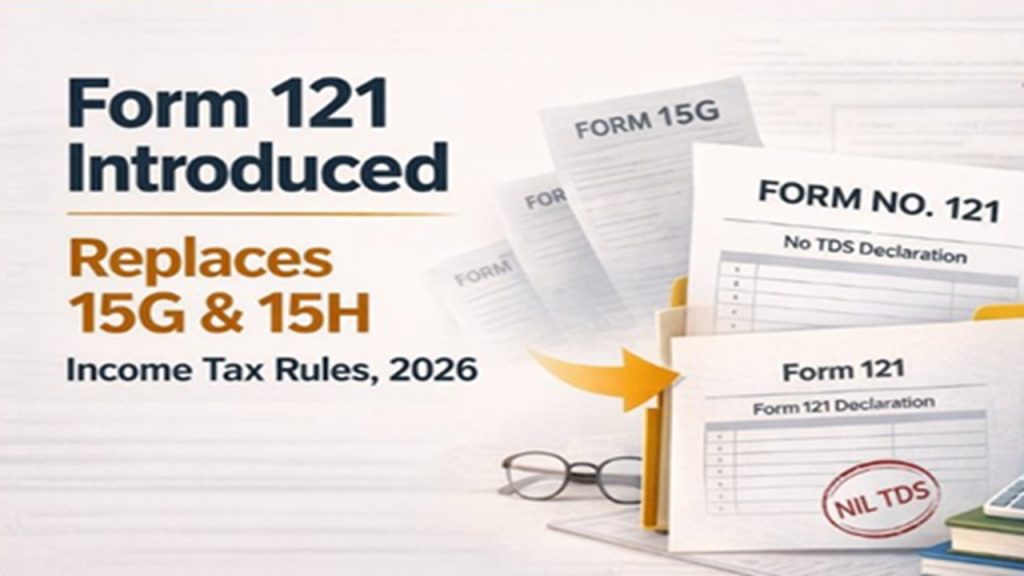
April 1, 2026 brought one of those tax changes that looks small on paper but matters a lot for savers, pensioners, and anyone trying to avoid unnecessary TDS. Forms 15G and 15H have now been replaced by a single declaration, Form 121, under the Income-tax Act, 2025 and Income-tax Rules, 2026. The basic goal stays familiar: if your estimated total tax for the year is nil, you can submit this declaration to the payer so tax is not deducted at source.
What Form 121 Actually Does
Form 121 is a self-declaration for certain incomes where the taxpayer expects nil tax liability for the tax year. Once given to the concerned payer, it can stop TDS on eligible receipts such as interest on deposits, dividends, rent, PF withdrawals, pension, insurance commission, mutual fund income, and some life insurance policy payments. The declaration is made under Section 393(6) of the Income-tax Act, 2025, read with Rule 211 of the Income-tax Rules, 2026.
Why Forms 15G And 15H Were Replaced
The biggest reason is simplification. Earlier, taxpayers below 60 usually used Form 15G, while senior citizens used Form 15H. From tax year 2026-27 onward, both age groups now use Form 121. The Income Tax Department’s transition FAQ also confirms that for any tax year beginning on or after April 1, 2026, the declaration must be furnished in Form 121.
Who Can Use Form 121
Resident individuals below 60, resident senior citizens, HUFs, and certain other eligible entities can use it, subject to the usual nil-tax conditions. Companies, firms, and non-residents cannot file Form 121. PAN is mandatory, and without PAN, the declaration becomes invalid and the payer must deduct TDS at the applicable rate.
One Change People Should Not Miss
This is not a one-time lifetime switch. Form 121 has to be furnished separately for every tax year, and it must be submitted to each payer responsible for the income. So if you have multiple banks or income sources, one form will not automatically cover everything.
Why This Change Is Trending Right Now
This update is getting attention because it lands with the wider April 2026 tax reset under the new law. The department’s guidance notes also point to a cleaner tracking system, including a single UIN framework for a PAN in a tax year, aimed at reducing duplication and reconciliation issues. Taxology’s official X post communication on new form identities also highlighted that 15G/15H is now Form 121, which helped push the change into mainstream discussion this week.
FAQs
Is Form 121 mandatory for everyone?
No, only eligible taxpayers wanting nil TDS on specified income need to submit it yearly.
Does Form 121 apply from April 1, 2026?
Yes, it applies for tax years beginning on or after April 1, 2026 officially.
Can senior citizens still use Form 15H?
No, senior citizens must now use Form 121 instead of Form 15H from April.
Do I need to submit Form 121 to every bank?
Yes, each payer needs its own declaration unless systems specifically support linked retrieval separately.
Is PAN required while filing Form 121?
Yes, PAN is mandatory, or the declaration becomes invalid and TDS may still apply.
More Stories Worth Your Time
Explore Why Keir Starmer Spoke Urgently?
Explore the key reasons behind the address.
Discover What Fans Think Of Rama?
Discover reactions to Ranbir’s glimpse.
Check How INS Malwan Strengthens Defence?
Check its features and capabilities.