

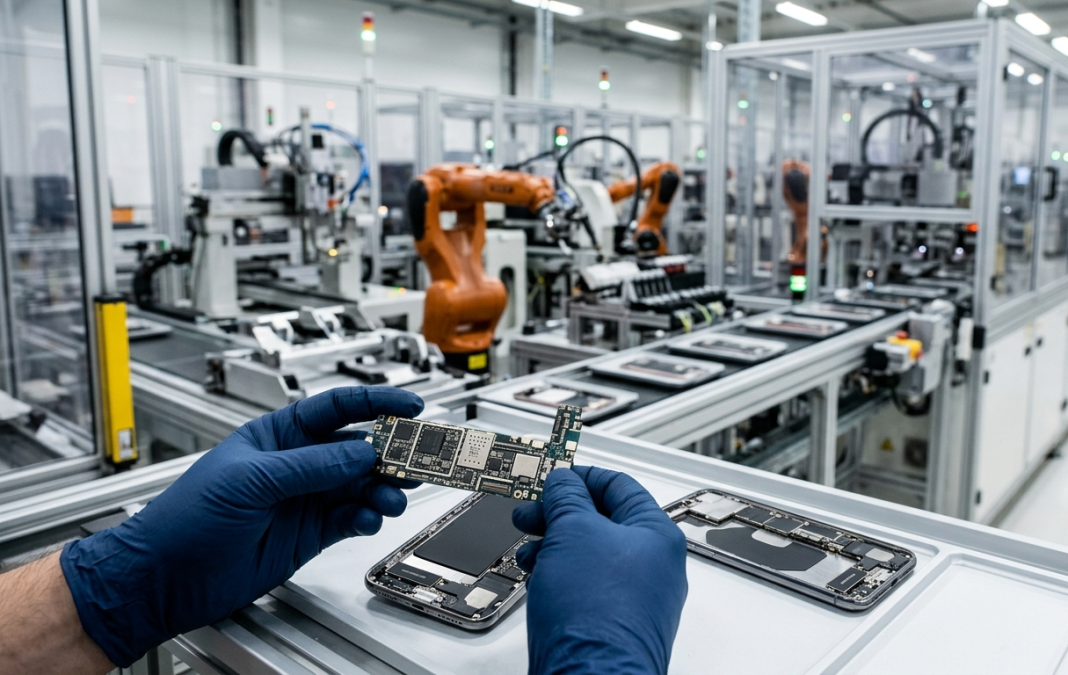

India has approved a fresh policy push for mobile phone factories just as its earlier handset incentive programme closes. On 15 July 2026, the Union Cabinet cleared the Mobile Phone Manufacturing Scheme, or MPMS, with a ₹62,500 crore budget.
India already makes 99.2% of the handsets used in the country and ranks second globally by production volume. The next test is whether it can manufacture displays, camera modules, batteries, circuit boards, and other high-value parts while creating Indian brands that sell abroad. The official Cabinet release places those goals at the centre of MPMS.
What Has The Cabinet Approved Under MPMS?
The Mobile Phone Manufacturing Scheme will operate from FY 2026-27 to FY 2030-31. Companies can receive incentives ranging from 2.25% to 5% on eligible phone sales. An additional incentive of up to 1.5% will be linked to domestic sourcing of selected components and sub-assemblies. Indian brands may also receive another 3% for product design and research and development.
The government expects the scheme to deliver:
- Cumulative mobile phone production of about ₹39 lakh crore during the five years
- A major increase in phone exports, with a reported target of ₹15 lakh crore
- Around 60,000 direct manufacturing jobs
- More patents, Indian product designs, and locally owned technology
- Stronger supply chains for components and sub-assemblies
Prime Minister Narendra Modi also highlighted the approval through an official post on X, saying it would expand production, domestic value addition, and global competitiveness.
Why Was A New Phone Scheme Needed After The PLI?
The Production Linked Incentive Scheme for Large Scale Electronics Manufacturing ended on 31 March 2026. It helped turn mobile phones from a heavily imported product into one of India’s strongest manufactured exports. Electronics production grew sevenfold and exports rose elevenfold from FY 2014-15. Smartphones became India’s largest exported product category in 2025.
The earlier programme attracted ₹20,587 crore in investment, according to figures shared after the Cabinet meeting. Reported smartphone production reached ₹11.62 lakh crore, while exports touched ₹6.43 lakh crore during its tenure. The government disbursed ₹19,090 crore in incentives and said the sector generated ₹25,000 crore in direct taxes and ₹3 lakh crore in GST. The Economic Times report carries the minister’s figures.
From Assembly Lines To Indian Technology
MPMS shifts the focus from increasing unit production to retaining more value inside India. A locally assembled phone may still use imported chips, screens, sensors, memory and specialised machinery. The domestic-sourcing incentive gives manufacturers a financial reason to move selected suppliers closer to Indian plants.
Can India Make More Phones Locally Under The New Scheme?
Yes, production can rise further, but success will depend on suppliers rather than final assembly alone. India already hosts facilities linked to Apple, Samsung, Foxconn, Tata Electronics, and Dixon Technologies. Apple has also moved more iPhone production towards India as companies reduce dependence on China-centred supply chains. Reuters reported that India produced nearly $60 billion of mobiles in FY 2024-25 and exported about $21.7 billion.
A recent approval for a Dixon Technologies and Vivo joint venture adds another timely development. The partnership can combine Vivo’s manufacturing knowledge with Indian majority ownership and Dixon’s factory network. Such arrangements may bring technical expertise while keeping more production capacity under domestic control.
Imported semiconductor components remain a pressure point. Global phone shipments fell sharply in the second quarter of 2026 as memory shortages raised costs and handset prices. India’s parallel ₹1.27 lakh crore Semicon 2.0 programme could support MPMS through chip design, fabrication, packaging, and related infrastructure.
What Could MPMS Change For Jobs, Exports And Buyers?
For workers, the immediate promise is 60,000 direct jobs, with further opportunities across logistics, tooling, testing, packaging, and supplier factories. Large electronics plants have already hired many young workers, including women from smaller towns and villages.
For exporters, stable incentives can support fresh production lines, global orders, and competition with China and Vietnam. For Indian brands, the design and R&D incentive is notable because it rewards product ownership and patents, not only factory output.
Buyers may not see instant price cuts. Incentives are paid to qualifying manufacturers, while retail prices still depend on chips, currency movements, taxes, and global demand. Over time, a wider local supplier base could reduce shipping delays and exposure to overseas disruptions.
India can make more phones locally under MPMS. The tougher goal is making more of each phone locally. The scheme will be judged by component factories, Indian patents, export orders, and globally competitive home-grown brands, not merely by boxes leaving assembly lines.
FAQS
What Is The Mobile Phone Manufacturing Scheme?
It is a five-year incentive programme supporting phone production, local sourcing, design, exports, and jobs.
How Much Has The Government Allocated For MPMS?
The Union Cabinet has approved a total budgetary outlay of ₹62,500 crore for five years.
When Will The New Mobile Manufacturing Scheme Run?
It will operate from FY 2026-27 through FY 2030-31, covering five financial years in total.
Will MPMS Make Mobile Phones Cheaper In India?
Prices may not fall immediately because chips, taxes, currency rates, and global demand affect costs.
How Many Direct Jobs Could The Scheme Create?
The government expects MPMS to generate around 60,000 direct jobs across mobile phone manufacturing operations.