

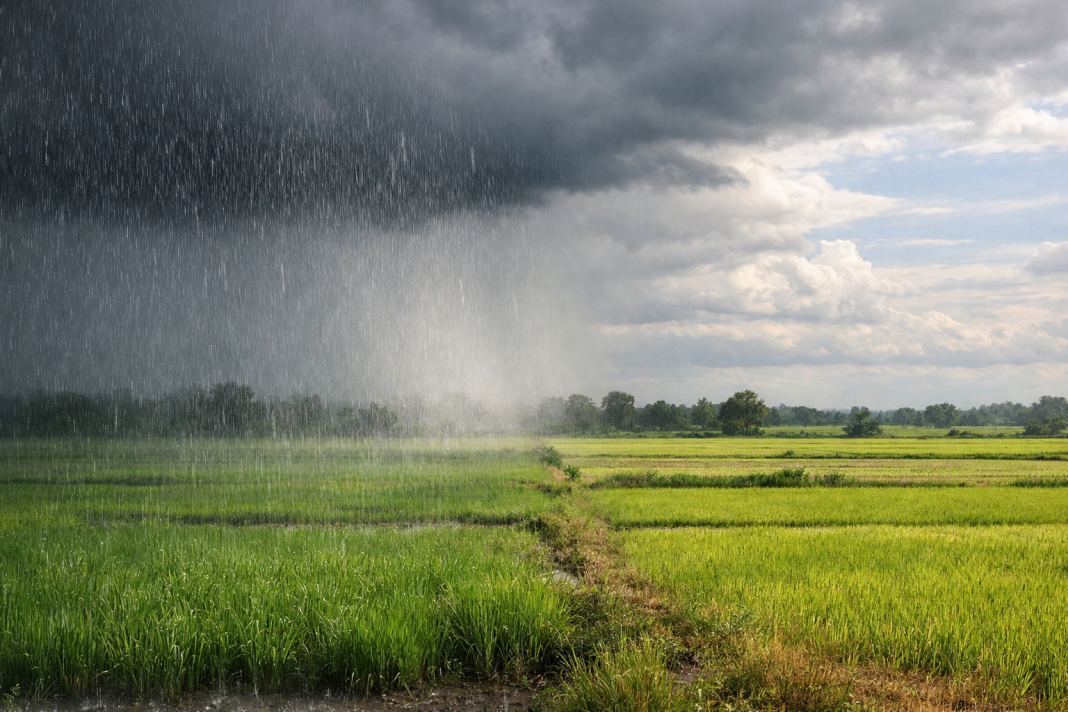

India may enter the most crop-sensitive stretch of the southwest monsoon with less rain than usual. The India Meteorological Department has forecast below-normal rainfall for August 2026 and the combined August-September period. Both could finish below 94% of the long-period average. Moderate El Niño conditions are already present and may strengthen through the remaining monsoon weeks.
The warning follows a welcome recovery in July. Rainfall during the month ended around normal, cutting the season’s nationwide deficit to roughly 12.6% from 35.4% at June-end. That revival helped farmers restart delayed planting. August, however, is when recently sown paddy, pulses, soybean, maize and cotton need steady soil moisture rather than a few dramatic cloudbursts.
Key Highlights
- August rainfall may remain below 94% of its long-period average of 254.9 mm.
- August and September together could receive less than 94% of the 422.8 mm average.
- Many regions face a drier signal, though parts of eastern peninsular, central and northwest India may fare better.
- Above-normal daytime temperatures are likely across most of India, adding pressure where showers weaken.
Why Has The August Forecast Turned Drier?
The IMD’s official August outlook says warm sea-surface anomalies across the central and eastern equatorial Pacific have produced moderate El Niño conditions. Its Monsoon Mission model expects further strengthening through September. The agency currently expects the Indian Ocean Dipole to remain neutral, although some international models indicate that a positive phase could develop in September.
El Niño often weakens the large-scale circulation carrying moisture towards the Indian subcontinent, but it does not switch off the monsoon everywhere. The forecast map shows normal or above-normal chances across several pockets even while the national total remains low. One district may face a long rain break while another receives flooding rain from a low-pressure system.
The World Meteorological Organization’s latest El Niño update expects a strong event during August-October, while NOAA gives El Niño a 97% chance of continuing into early spring 2027. Neither forecast guarantees drought across India, but both support closer weekly monitoring.
IMD also posted the forecast through its official X account, giving farmers, traders and state agencies a direct source for the national outlook.
How Could Lower Rain Affect Crops And Food Prices?
Planting has recovered sharply, yet the crop calendar remains exposed. According to the Agriculture Ministry’s latest kharif sowing update, farmers had covered 787.37 lakh hectares by July 24, compared with 826.19 lakh hectares one year earlier. Rice acreage was 234.43 lakh hectares, pulses 84.57 lakh hectares and maize 77.79 lakh hectares, all below last year’s levels.
A dry August can reduce tillering in paddy, pod formation in pulses and moisture availability for oilseeds. Irrigated fields have some protection, but rain-fed belts remain vulnerable. Farmers may spend more on pumping, diesel or repeated sowing. If yields weaken across several crops, pressure could later appear in cereal, edible-oil, pulse and fodder prices.
Still, a below-normal monthly total does not mean every week will be dry. The IMD extended-range forecast points to active rain over western and central India during early August, with heavy to very heavy falls possible. Such bursts can refill tanks, yet they may also cause waterlogging, landslides and crop damage before another dry spell arrives.
What Should India Watch Through September?
The next signals will be rainfall distribution, reservoir inflows, soil moisture and the number of monsoon breaks. State advisories will need district-level forecasts because the national average can hide sharp local shortages. Farmers with irrigation access may schedule protective watering, while those in rain-fed areas may favour shorter-duration varieties, drainage work and moisture conservation.
The Indian Ocean Dipole is another variable. IMD currently expects neutral conditions to continue, while some international centres see a positive phase developing in September. The department will issue its September forecast near August-end. Until then, below-normal August rainfall is a warning, not a fixed outcome. The final crop impact will depend on where rain falls, how long breaks last and whether late-season systems revive the monsoon.
Frequently Asked Questions
What does below-normal rainfall mean?
IMD classifies rainfall below 94% of the long-period average as below normal for this period.
Will El Niño cause drought across India?
No, it raises dry-season risks, but regional rain systems can still produce intense local downpours.
Which crops face the greatest August risk?
Paddy, pulses, soybean, maize, cotton and millets need timely rain during critical growth stages now.
Can heavy rain still occur during a deficient month?
Yes, short, violent spells may strike even when India’s overall monthly rainfall stays below normal.
When will IMD update the September forecast?
IMD plans to release its detailed September rainfall outlook near the end of August 2026.