
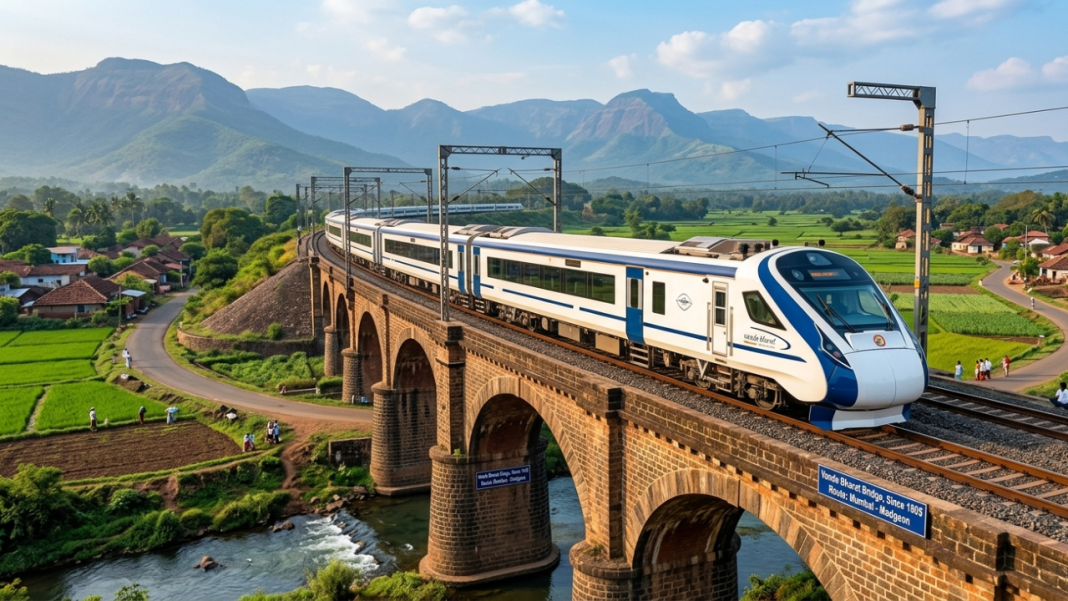

Indian Railways has taken another step toward giving freight the Vande Bharat treatment. India’s first Vande Bharat-based Freight EMU underwent a loaded trial at 130 kmph on the Kota–Rohal Khurd section of West Central Railway on August 14, putting the spotlight on faster parcel movement.
The trial was not a commercial launch. It formed part of a technical programme supervised by the Research Designs and Standards Organisation (RDSO) and Integral Coach Factory (ICF), Chennai. The test arrives as Railways expands freight corridors, cargo terminals and door-to-door parcel services while trying to win more business from road transport.
What Happened During The 130-Kmph Vande Bharat Freight Trial?
According to The Indian Express, engineers checked regenerative energy, thermal capacity, traction, braking and jerk levels while the rake ran under loaded conditions. Teams were studying how its electrical, propulsion and braking systems behaved when cargo weight was added.
This was not the prototype’s first fast run. Trials began on July 29 across the Kota–Nagda–Sawai Madhopur section. On the opening day, the rake reportedly touched 145 kmph on its return from Mahidpur Road to Kota. The programme also covers oscillation, emergency braking distance, coupler force, curve performance, signal interference and door-operation tests.
The Kota Division shared footage of the latest run through its official DRM Kota X account, confirming the 16-coach Freight EMU test at 130 kmph.
Key points from the latest test include:
- The prototype has 16 coaches and uses the Vande Bharat trainset platform.
- The August 14 test examined the rake under loaded conditions.
- RDSO and ICF teams were present during the technical assessment.
- Commercial operations have not started yet.
How Is The Vande Bharat Freight Train Different From A Regular Goods Train?
The biggest change is the trainset format. Traditional freight trains generally depend on a locomotive hauling separate wagons. The Vande Bharat Freight EMU uses distributed traction and is designed as an integrated rake, helping acceleration, braking and higher-speed operation.
Its layout is aimed at parcels rather than bulk cargo such as coal or iron ore. The prototype includes parcel coaches and reefer vans, along with pneumatic retractable roller flooring, wide automatic sliding doors, CCTV, fire detection and container-locking arrangements. An earlier trial report put payload capacity at about 397 tonnes.
That points to a different market from conventional heavy freight. E-commerce parcels, refrigerated products, packaged goods and other time-sensitive consignments are obvious targets. In those categories, hours saved in transit can influence whether a shipper chooses rail or road.
Why Could Fast Cargo Fit Railways’ Bigger Freight Strategy?
Indian Railways already moves huge volumes. A Ministry of Railways release dated August 7, 2026 said freight loading reached 1,670 million tonnes in 2025–26, making Indian Railways the world’s second-largest freight-carrying railway system.
The same release said 142 Gati Shakti Cargo Terminals had been commissioned, with estimated handling capacity of 224 million tonnes per year. Railways is also running Joint Parcel Product-Rapid Cargo Service initiatives and CONCOR door-to-door services.
The Eastern and Western Dedicated Freight Corridors are fully commissioned and average about 443 trains per day. A new Dankuni-to-Surat freight corridor was also announced in Union Budget 2026, with DPR work underway.
This is where the Vande Bharat freight idea becomes more interesting. It need not replace heavy freight. It could create a premium rail product for cargo that values speed, fixed schedules and predictable delivery.
Could High-Speed Freight Become The Next Vande Bharat Expansion?
There is a strong case, but the business test will be tougher than the speed test. Railways must identify routes with enough parcel volume in both directions, keep loading quick, provide reliable terminal slots and price the service against road and air cargo.
The National Rail Plan targets a larger railway share of India’s freight market and faster average freight movement. A 130-kmph parcel train could help at the premium end, especially between large manufacturing, consumption and e-commerce hubs.
Still, one prototype does not create a network. Regular high-speed cargo would need suitable paths, terminals, maintenance, cold-chain links and customers willing to commit volumes. The trials are important because they test whether Vande Bharat technology can move beyond passengers while staying reliable under freight loads.
If those pieces fall into place, the next big Vande Bharat story may not be another passenger route. It could be packages arriving overnight by rail.
FAQs
Is the Vande Bharat freight train already in commercial service?
No. The prototype remains under testing, with further safety checks required before freight operations begin.
What kind of cargo could the Vande Bharat freight train carry?
It targets parcels, e-commerce shipments, refrigerated goods and other time-sensitive loads needing faster rail movement.
How fast has the Vande Bharat freight train travelled during trials?
The August loaded trial ran at 130 kmph, while earlier testing had reached 145 kmph.
Who developed India’s first Vande Bharat Freight EMU?
ICF Chennai developed the 16-coach Freight EMU, with RDSO teams supervising its technical trial programme.
Why is the Vande Bharat freight train important for Indian Railways?
It could give Railways a parcel product for sectors where delivery time drives logistics choices.