

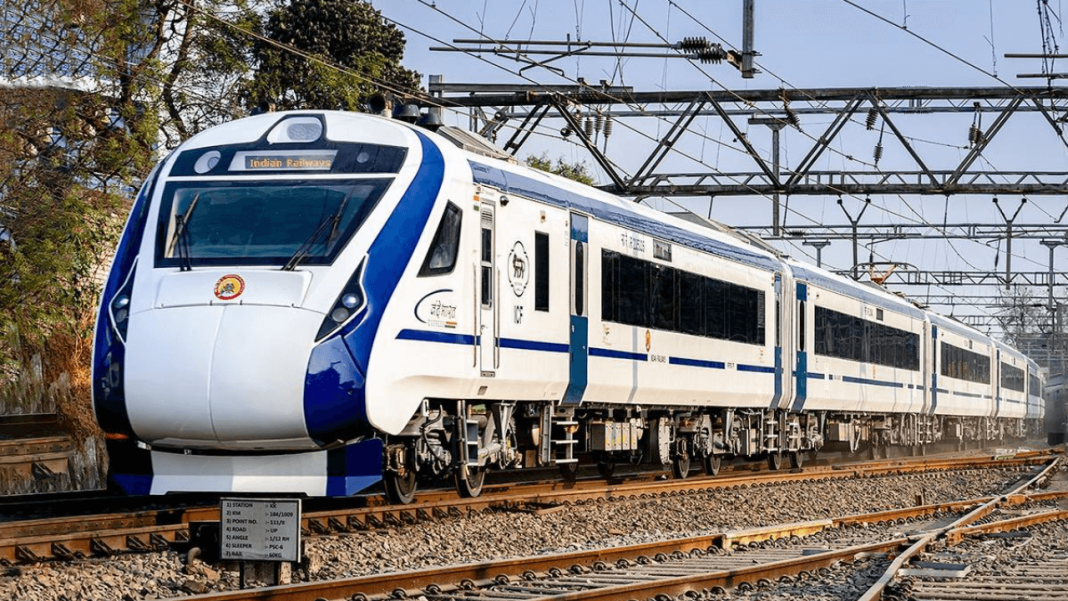

India’s first Vande Bharat-based freight train has entered a month-long trial programme after touching 145 kmph on its opening test day. The 16-coach Freight EMU, built by Chennai’s Integral Coach Factory, is being checked on the Kota-Nagda-Sawai Madhopur section under the supervision of the Research Designs and Standards Organisation.
The figure has drawn attention because conventional freight services usually run much slower. Yet the main question is not whether the rake can briefly reach 145 kmph. Engineers must establish whether it can remain stable, brake safely and protect cargo while running loaded at that speed.
What Happened During The First Vande Bharat Freight Trial?
The trial series began on July 29, 2026, in the Kota Division of West Central Railway. According to the Indian Express report on the first run, the rake left Kota for Mahidpur Road at 6 am.
It first ran at 120 kmph between Kota and Mahidpur Road. Recorded tests of 120 kmph and 135 kmph followed between Mahidpur Road and Bhawani Mandi. On the return journey to Kota, the train reached 145 kmph, its highest speed during the opening day. urn469242view1
Railway officials plan at least two round trips daily across the trial period. The high-speed corridor around Kota has previously hosted tests for new passenger trainsets because it offers suitable track, signalling and operating conditions.
The first-day result is encouraging, although it is not a commercial speed certificate. RDSO must still examine how the train behaves across curves, braking zones, changing track conditions and repeated high-speed runs.
Can The Freight EMU Hold 145 Kmph With A Full Load?
That is exactly what the next phase will examine. The trial schedule includes oscillation checks at 120, 130, 140 and 145 kmph in loaded and inflated conditions. Engineers will measure lateral movement, vibration, wheel-rail behaviour, coupler forces and braking distance.
The planned checks include:
- Emergency braking distance and stopping response
- Stability and oscillation at four speed levels
- Coupler force, curves, traction, braking and jerk
- Door locking, CCTV, lighting and fire detection
- Signal interference, regenerative energy and onboard systems
The train can carry about 397.02 tonnes. Reaching 145 kmph once shows that its propulsion system has the required power. Maintaining that speed with cargo, however, requires predictable braking, low vibration and safe load distribution during repeated journeys.
Commercial operation may therefore be cleared at a lower speed than the maximum test speed. Earlier railway reporting indicated a likely operating target of around 130 kmph. Testing above that level creates a safety margin before approval. Does the Vande Bharat Freight Train Make It Different?
The rake uses the Vande Bharat platform but has been redesigned for parcels rather than passengers. It contains two Driving Trailer Coaches with reefer facilities, two Non-Driving Trailer Coaches and 12 parcel coaches.
The Economic Times report on the technical trials says the train has an axle-load capacity above 20 tonnes and carries the KAVACH automatic train-protection system.
Its parcel coaches have pneumatic retractable roller floors for quicker movement of goods. Wide automatic sliding doors support loading, while forced ventilation and refrigerated sections can protect temperature-sensitive consignments. Doors lock automatically once the train crosses 5 kmph, and the rake cannot move unless closure is confirmed. 0turn469242view1
These features could suit e-commerce parcels, medicines, dairy items, seafood, fruit, flowers, electronics and other time-bound shipments. Fast loading will be as important as speed because delays at terminals can erase gains made on the track.
Could This Train Change India’s Express Cargo Market?
The Freight EMU is aimed at a space between slow bulk freight and expensive air cargo. It could serve businesses that need predictable overnight or same-day movement between large production, consumption and logistics centres.
The project also fits India’s wider push towards modern rail cargo terminals. A Press Information Bureau update on Gati Shakti Cargo Terminals said 118 terminals had been commissioned, with combined estimated capacity of 192 million tonnes annually. Faster trainsets will still need compatible terminals, road links, loading windows and reliable schedules. sful certification would not mean every freight train starts running at 145 kmph. This is a specialised parcel EMU for lighter, higher-value and time-sensitive loads. Its commercial case will depend on pricing, route demand, terminal turnaround and dependable delivery times.
Frequently Asked Questions
When did the Vande Bharat freight train trial begin?
The technical trial programme began on July 29, 2026, in West Central Railway’s Kota Division.
What speed did the freight train achieve?
It reached 145 kmph while returning from Mahidpur Road to Kota during its first trial.
How much cargo can the train carry?
The sixteen-coach Freight EMU has a payload capacity of about 397 tonnes for express parcels.
Will it commercially operate at 145 kmph?
Commercial speed remains unconfirmed and will depend on RDSO safety, braking, stability and loaded-trial results.
Which goods could use this freight service?
It may carry e-commerce parcels, medicines, perishables, electronics and other urgent, high-value consignments efficiently nationwide.