

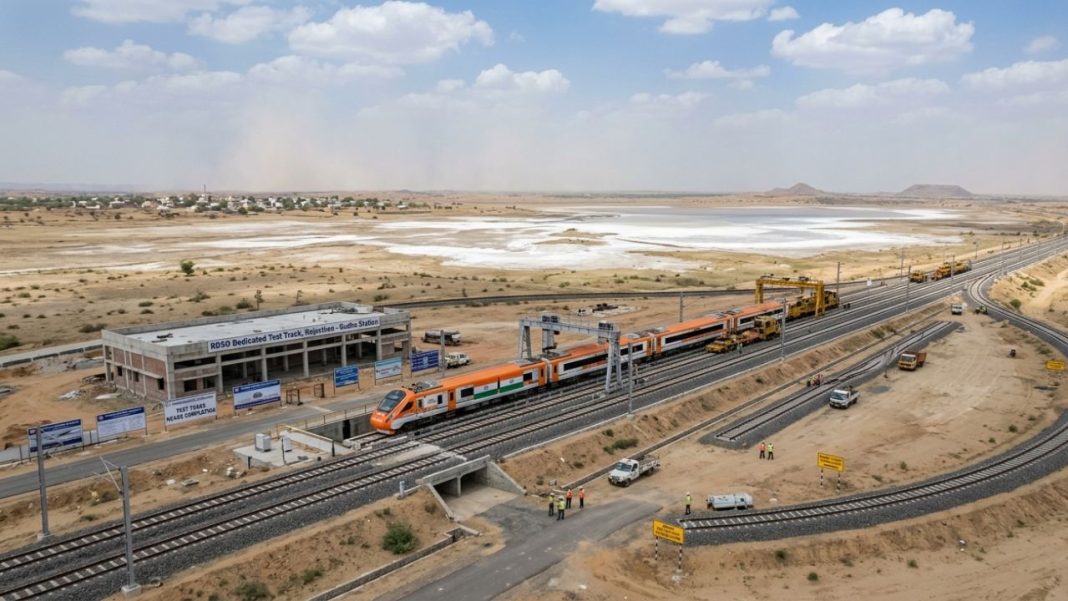

India’s first dedicated high-speed railway test track is nearing completion in Rajasthan, with Indian Railways preparing a purpose-built facility where new trains and railway systems can be pushed beyond normal passenger-service speeds. The latest North Western Railway update says the 59-km broad-gauge facility between Gudha and Thathana Mithri will support trials at up to 220 kmph, with rolling-stock testing expected from 2027-28.
The RDSO-developed project, costing ₹967.07 crore, sits in the Nawa region of Jodhpur Division, around 70 km from Jaipur. It is being built for speed, braking, stability, track, signalling, and infrastructure trials.
What Is Happening At Rajasthan’s High-Speed Test Track?
North Western Railway says the project has entered its final construction stretch. A 31.5-km high-speed section and the 3-km accelerated testing loop at Nawa are almost finished and targeted for completion by September 2026. The 20-km curve-testing loop at Mithri is also at an advanced stage and should become operational by the end of 2026.
Different sections recreate conditions needed for dynamic, curve, endurance and component testing. A 4.5-km twisted track for static testing of rolling stock has already been completed and commissioned.
Key features of the Rajasthan facility include:
- A 23-km main line for general testing and validation.
- A 13-km high-speed loop at Gudha for faster dynamic trials.
- A 3-km accelerated testing loop at Nawa for repeated test cycles.
- A 20-km curve-testing loop at Mithri, plus seven major bridges, 129 minor bridges, and four stations.
The latest project position was detailed by North Western Railway officials in an Indian Express report published on August 24, 2026.
What Speeds Will New Trains Be Tested At?
The headline figure is 220 kmph. That is the officially stated design testing speed for the dedicated track, higher than the design speed of today’s Vande Bharat trainsets. A Railway Ministry reply in Parliament also described the project as offering rolling-stock trials up to a design speed of 220 kmph.
That does not mean every train arriving at the facility will immediately run at 220 kmph. Test speeds depend on the vehicle, certification programme and engineering objective. Vande Bharat sets, locomotives, coaches, wagons and potentially other rolling stock can be assessed under different test profiles.
Some older reports have mentioned 230 kmph trials, but the latest North Western Railway update and government material continue to cite 220 kmph. For readers tracking the project, 220 kmph remains the safer official benchmark.
Why The 220 Kmph Test Ceiling Is Significant
Indian Railways has previously carried out high-speed trials on operational sections, requiring traffic blocks and coordination with regular services. A dedicated line gives engineers more room to repeat braking, oscillation, stability, and endurance tests without tying up a busy passenger corridor.
It could also shorten the route from prototype to certification for future rolling stock. RDSO’s testing work covers far more than a train’s top-speed run, so repeatability becomes valuable.
Why This Track Goes Beyond Speed Trials
The Rajasthan facility will test track materials, bridges, traction distribution equipment, signalling systems and geotechnical parameters alongside rolling stock. North Western Railway has completed changes at Gudha station to connect the test track with the existing network, including modifications to electronic interlocking and indication circuits covering 18 points.
Railway officials say the facility is being developed for comprehensive rolling-stock testing aligned with UIC-518 and EN-14363 standards. That puts ride behaviour, stability and dynamic performance at the centre of the project rather than a single speed record.
North Western Railway has also shared project visuals through its social-media presence. Recent coverage credited photographs of the nearly completed facility to North Western Railway’s official X account, offering a closer look at work underway in Rajasthan.
How The Rajasthan Track Fits India’s Faster-Train Push
The timing is notable. India’s Vande Bharat Sleeper completed a 180 kmph CRS high-speed trial on the Kota-Nagda section in December 2025, according to the Ministry of Railways. In May 2026, Modern Coach Factory’s first Vande Bharat trainset was also dispatched for testing and field trials.
The Rajasthan test track should not be confused with the Mumbai-Ahmedabad Bullet Train corridor. The latter is a separate standard-gauge passenger project designed for 350 kmph and planned for an operational speed of 320 kmph, according to the government’s high-speed rail project update. The Rajasthan facility is a broad-gauge research and certification asset for testing rolling stock and railway systems.
If the remaining work stays on schedule, 2027-28 could mark the point when India begins routine high-speed rolling-stock testing on a dedicated domestic facility rather than borrowing time from working railway routes.
FAQS
What is the maximum testing speed on Rajasthan’s high-speed rail test track?
Trains and rolling stock will undergo trials at speeds of up to 220 kmph there.
Where is India’s first dedicated high-speed railway test track located?
The dedicated broad-gauge test track runs between Gudha and Thathana Mithri in Rajasthan’s Jodhpur Division.
When will train testing begin on the Rajasthan high-speed track?
Railway officials expect rolling-stock trials, including Vande Bharat testing, to begin from 2027-28 onwards there.
Who is developing India’s high-speed railway test track?
RDSO is developing the facility, while North Western Railway has administrative control over the project.
Is this Rajasthan test track part of India’s Mumbai-Ahmedabad bullet train corridor?
No. India’s Mumbai-Ahmedabad bullet train corridor is separate and targets 320 kmph operational speeds eventually.
More Business & Infrastructure News
Maharashtra FDA Suspends McDonald’s And Other Food Licences Over Flies, Cockroaches And Stale Food