

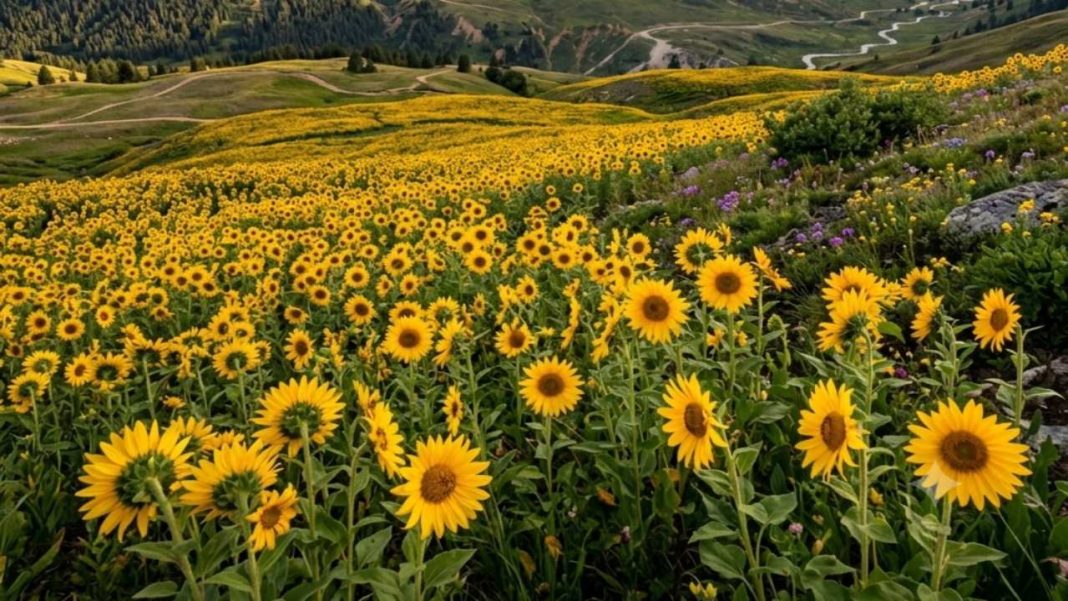

A yellow-flowered plant growing on a cold mountain slope in Arunachal Pradesh has rewritten one small but striking part of India’s botanical map. Researchers from the CSIR-Institute of Himalayan Bioresource Technology, or CSIR-IHBT, have described Doronicum sanctum, a new species in the sunflower family Asteraceae, from Tawang district at roughly 4,086 metres above sea level.
The find is unusually important because Doronicum, commonly called Leopard’s bane, had never been documented from Northeast India. Earlier Indian records came from the western Himalaya. The discovery therefore raises an obvious question: was the plant newly established in Tawang, or had botanists simply missed a tiny alpine population for years? The available evidence points much more strongly to the second possibility.
What Scientists Found High Above Tawang
Researchers Rahul Kumar and Vikas Kumar identified Doronicum sanctum during botanical surveys in the eastern Himalaya. The plant was recorded on rugged slopes on the route to Damteng, close to the Chumi Gyatse Holy Waterfalls. Its formal description appeared in the peer-reviewed Biologia study in August 2026.
Key facts about Doronicum sanctum:
- It belongs to Asteraceae, the same large plant family as sunflowers and daisies.
- It was found at about 4,086 metres in Tawang district, Arunachal Pradesh.
- It is the first Doronicum species recorded from Northeast India.
- Researchers observed only around 10 to 12 individuals at the known location.
- Its provisional conservation assessment is Data Deficient because scientists still lack enough population data.
CSIR-IHBT also shared the discovery through its official X announcement on Doronicum sanctum, calling it the first discovery of its kind in Northeast India. That gives the story a direct institutional source alongside the published scientific work.
Why Had Doronicum Sanctum Gone Unrecorded For So Long?
There is no published claim that one single factor kept Doronicum sanctum hidden. Still, the circumstances offer several clues.
First, India’s known Doronicum records were concentrated in the western Himalaya. A botanist working from older distribution records would have had little reason to expect the genus on a remote Tawang slope. Second, the known population is exceptionally small. Finding 10 or 12 plants across steep alpine terrain is very different from spotting a widespread roadside species.
Altitude adds another problem. Around 4,000 metres, field seasons are short, weather changes quickly and access can be difficult. Alpine plants may also flower for a limited window, so a survey conducted too early or too late can pass the same site without seeing useful identifying features.
Then there is resemblance. Doronicum sanctum looks similar in some respects to D. conaense and D. stenoglossum, species associated with Tibet and China. That resemblance can complicate field identification, making microscopic examination, herbarium checks and comparison with botanical literature especially important.
So “never recorded” should not be read as “never present.” It is more accurately a reminder that high Himalayan plant inventories remain incomplete. That makes the find a taxonomic first and a warning against treating old distribution maps as final.
How Scientists Knew This Was A Separate Species
Naming a new species takes more than noticing an unfamiliar yellow flower. The CSIR-IHBT team collected specimens, examined their structure with stereo microscopy and checked them against herbarium material and botanical literature.
Doronicum sanctum has pubescent ray cypselae, meaning the dry fruits around the outer part of the flower head are hairy. It also carries a caducous pappus, a feathery structure that drops away early. Its dilated flower-stalk tip, lance-shaped green bracts and the form of its ray florets further separate it from its closest lookalikes.
The name “sanctum” comes from the Latin for sacred or holy. Researchers chose it because the type locality lies near Chumi Gyatse Holy Waterfalls, a spiritually important place for local communities.
Tawang Is Becoming A Hotspot For Botanical Surprises
Doronicum sanctum is not Tawang’s first high-altitude botanical surprise. In 2021, scientists described Cremanthodium indicum, another Asteraceae plant, from Penga-Teng Tso Lake at about 4,100 metres. The Arunachal Times report on that discovery said researchers recorded about 270 mature individuals and assessed the species as critically endangered.
Arunachal Pradesh has stayed active on the discovery map in 2026 as well. Researchers published a new wild-kiwi species from Arunachal Pradesh, while another study documented six additions to the known flora of Assam and Arunachal Pradesh. Fresh fieldwork in the eastern Himalaya is clearly still changing India’s botanical record.
FAQs About Doronicum Sanctum
Where Was Doronicum Sanctum Discovered?
Scientists found it in Tawang district, Arunachal Pradesh, at 4,086 metres above sea level.
Which Plant Family Does Doronicum Sanctum Belong To?
It belongs to Asteraceae, the large flowering-plant family that also includes sunflowers, daisies and marigolds.
Why Is Doronicum Sanctum Important For Northeast India?
It is the first confirmed Doronicum species ever scientifically documented from India’s northeastern Himalayan region.
Why Was The Species Named Sanctum?
The name refers to nearby Chumi Gyatse Holy Waterfalls, a site considered sacred by locals.
Is Doronicum Sanctum Already Considered Endangered?
Not yet; limited population evidence currently supports a provisional Data Deficient conservation assessment for scientists.
More About Tiny Alpine Flower and Environment
US Plans Up To 200% Tariffs On Generic Drugs: How Could Indian Pharma Companies Be Affected?