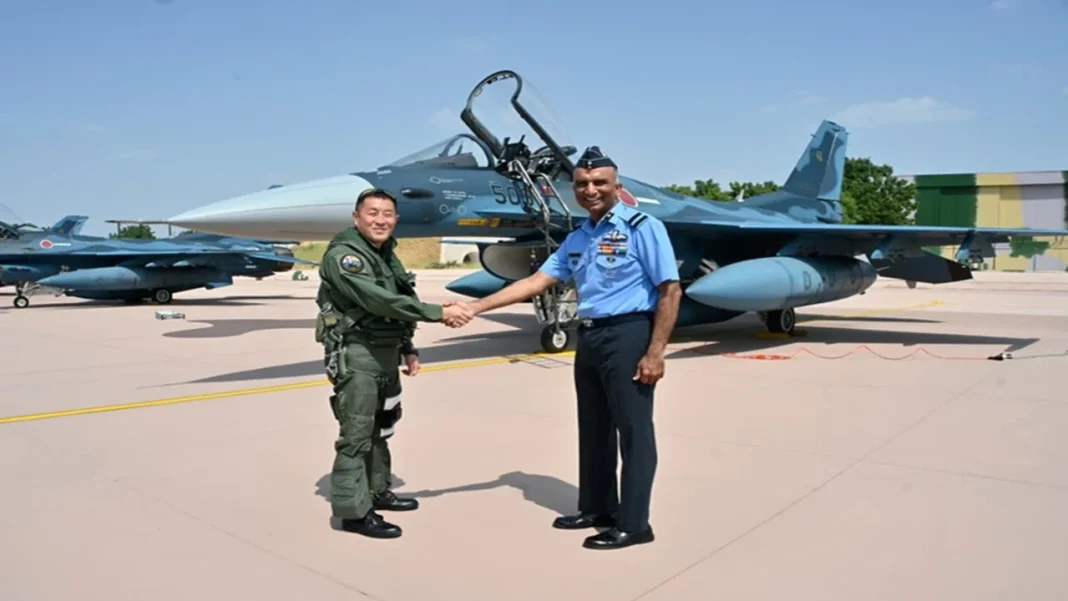

India and Japan began Exercise Veer Guardian 2026 at Air Force Station Jodhpur on September 9, bringing Japanese F-2A fighters to India for bilateral air-combat training for the first time. The Indian Air Force is fielding LCA Tejas, Su-30MKI and Rafale aircraft, creating a rare mixed-fighter training environment over Rajasthan. India’s Ministry of Defence released lists the exercise from September 9 to 22, while Japan’s official Air Staff Office notice lists flying training from September 9 to 21 and a wider deployment period extending through September 30.
What Is Exercise Veer Guardian 2026 And Who Is Taking Part?
Veer Guardian 2026 is the second edition of the bilateral fighter exercise between the Indian Air Force and the Japan Air Self-Defense Force. The inaugural edition took place in Japan in January 2023. This time, Jodhpur is hosting the fighters, crews and support teams.
Japan’s Air Staff Office says three F-2A fighters from the 8th Air Wing at Tsuiki Air Base and about 110 personnel are participating. Two JASDF C-2 transport aircraft had already reached Jodhpur with the Japanese contingent before the exercise opened. The Indian side has confirmed participation by Tejas, Su-30MKI, and Rafale fighters.
The main facts are:
- Dates: September 9-22 under India’s official schedule; Japan lists air training through September 21.
- Location: Air Force Station Jodhpur and surrounding airspace in Rajasthan.
- Japanese aircraft: Three Mitsubishi F-2A fighters from the 8th Air Wing.
- IAF aircraft: LCA Tejas, Su-30MKI and Rafale.
- Core aim: Improve tactical proficiency, interoperability and operational coordination between both air forces.
The Indian Air Force’s official X post showed the Japanese contingent’s arrival and said Veer Guardian would sharpen skills and strengthen India-Japan defence cooperation.
What Combat Drills Will IAF And Japanese F-2A Fighters Practise?
Japan’s official Veer Guardian notice gives the clearest named combat activity: air-combat manoeuvring. India’s Ministry of Defence adds that crews will fly advanced operational missions. Neither government has publicly released a detailed sortie-by-sortie combat syllabus, so claims about specific missile shots or strike packages should not be treated as confirmed.
Air-Combat Manoeuvring And Dissimilar Fighter Training
Air-combat manoeuvring places pilots in simulated fighter-versus-fighter situations where positioning, energy management, formation tactics, sensors, communications and rapid decision-making are tested. The mix is particularly valuable because the F-2A, Tejas, Su-30MKI and Rafale have different aerodynamic and sensor characteristics.
Mission planning is another confirmed part of the programme. Indian and Japanese crews will work through planning conferences before sorties, then compare procedures and operational approaches. The exercise also includes subject-matter expert exchanges, engineering interaction and aerospace-safety discussions, giving maintainers and safety teams a role alongside aircrew. No live missile firing or weapons release has been announced in either official programme released so far.
The location also gives both sides access to Air Force Station Jodhpur and its surrounding designated training airspace, the area specifically identified in Japan’s exercise programme.
Why Is Japan’s F-2A Fighter A Major Talking Point In India?
The F-2A has drawn attention because Japan developed it jointly with the United States using the F-16 as its starting point, then altered the design for Japanese requirements. Japan’s defence ministry says the aircraft received a larger wing, advanced materials, a higher-thrust engine and upgraded electronic equipment compared with the original F-16 design.
That does not make the F-2A identical to an F-16. Still, Indian pilots gain exposure to a fighter with related design lineage, while Japanese pilots train against aircraft they do not operate at home, especially the large Su-30MKI and Rafale. This is the practical value of dissimilar air-combat training: crews see how unfamiliar aircraft accelerate, turn and react to different tactical set-ups.
Japan currently fields F-35, F-15 and F-2 fighter types while developing its next-generation fighter with Britain and Italy. Exercises such as Veer Guardian broaden the aircraft, tactics and operating procedures encountered by Japanese crews.
Why Veer Guardian 2026 Carries Wider India-Japan Strategic Weight
The exercise follows an August 20 meeting between Defence Minister Rajnath Singh and Japanese Defence Minister Shinjiro Koizumi. Their India-Japan joint defence statement welcomed the first visit of Japanese fighter aircraft to India under Veer Guardian and called for bilateral exercises to become more complex, including future integration of unmanned systems.
For New Delhi and Tokyo, Veer Guardian sits alongside the Dharma Guardian army exercise and JAIMEX maritime exercise. The immediate focus in Jodhpur, however, remains flying together safely, comparing tactics and making mixed Indian-Japanese formations more effective during demanding air operations.
FAQs
1. Where Is Veer Guardian 2026 Being Held?
Veer Guardian 2026 runs at Air Force Station Jodhpur, with surrounding airspace supporting joint training.
2. How Many Japanese F-2A Fighters Are Participating?
Japan is deploying three F-2A fighters from its 8th Air Wing at Tsuiki Air Base.
3. Which Indian Fighter Aircraft Are Participating?
The IAF is fielding LCA Tejas, Su-30MKI and Rafale fighters during the bilateral Jodhpur exercise.
4. What Training Is Officially Confirmed?
Training includes air-combat manoeuvring, advanced missions, mission planning, engineering exchanges and aerospace safety discussions too.
5. Why Is This Edition Significant?
It is Veer Guardian’s second edition and Japan’s first fighter deployment to India for it.
You could also explore
Explore More Stories Shaping India Today
Could Visa-Free Uzbekistan Boost Indian Travel?
Check out how Uzbekistan’s new visa regime could reshape tourism and business travel for Indians.
How Are India’s Nepal Flood Rescue Efforts?
Find out how Indian authorities are tracking missing pilgrims and tourist groups after the devastating floods.
Which Foreign Assets Can Indians Declare?
Uncover which overseas bank accounts, shares, and properties can be disclosed under the new tax window.
What Missions Await India’s Space Sector?
Dive into the key missions, technologies, and opportunities scientists and startups may discuss at the conclave.
What Climate Decisions Could BRICS Deliver?
See what major climate and sustainability outcomes could emerge from the two-day BRICS environment meetings.