

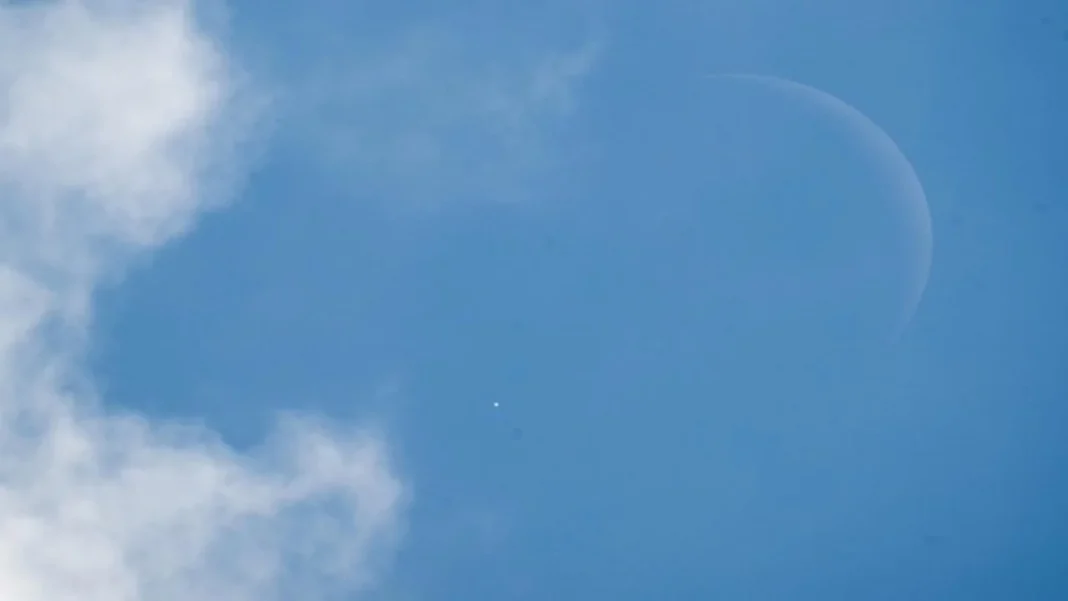

Venus will briefly vanish behind the Moon on September 14, 2026, during a lunar occultation visible across parts of Europe, Africa and Asia. India lies inside the wider visibility zone, but the sight will not look the same everywhere. Some locations can catch Venus being covered or reappearing near dusk, while others may only see an unusually close Moon-Venus pairing.
NASA lists today’s event as the second of three Venus occultations in 2026. A thin waxing crescent Moon will pass directly across brilliant Venus. The agency’s official lunar occultation update confirms that the September event favours parts of Asia, Africa, Europe and western Russia.
Key Highlights
- The global occultation runs from about 09:26 UTC to 13:42 UTC.
- India’s wider observing window falls roughly between 5:00 PM and 7:10 PM IST.
- The Moon is around 12% illuminated, while Venus shines near magnitude -4.4.
- Visibility changes sharply by city, so some places may see only the close conjunction.
- StarGazing India has announced live telescope coverage from 5:00 PM IST.
What Happens During The Venus Lunar Occultation?
A lunar occultation occurs when the Moon moves directly between Earth and a more distant object in the sky. From places inside the viewing path, the Moon completely blocks that object for a short period before it appears again.
That is exactly what Venus does today. According to NASA’s explanation of a lunar occultation, Venus is not fading or switching off. The Moon simply crosses an observer’s line of sight and hides the planet for a while.
The BBC Sky at Night observing guide reports that the Moon is about 12% illuminated, while Venus is also in a crescent phase and shines at roughly magnitude -4.4. Through binoculars or a telescope, observers may catch both shapes in the same field before or after the disappearance.
Can The Venus Occultation Be Seen From India Today?
Yes, parts of India can see the occultation, but there is no single nationwide timing. Published regional calculations place India’s country-level window at roughly 5:00 PM to 7:10 PM IST. Exact disappearance and reappearance times shift with location because the Moon’s apparent position changes slightly for observers standing in different parts of Earth.
The In-The-Sky occultation visibility map places India within the event track and shows the reappearance zone extending across the region. People near the path boundary may miss the full cover-up and instead see Venus pass extremely close to the Moon.
That is still worth watching. The Moon and Venus come within about half a degree of each other, close enough to fit comfortably inside a typical binocular field. StarGazing India has also scheduled live telescope coverage from 5:00 PM IST for viewers facing clouds, buildings or poor local viewing conditions.
How Can Skywatchers Watch The Event Safely?
The main challenge for Indian viewers is bright evening twilight. Venus is exceptionally bright, yet finding it beside a thin crescent Moon before sunset can still be difficult against a blue sky.
Choose an open western or south-western horizon with as few buildings and trees as possible. Binoculars can help after the Sun has safely dropped below the horizon. Telescope users trying before sunset must keep the instrument far away from the Sun because even a brief accidental view can cause severe eye injury.
A smartphone can capture the close pairing after sunset, though a telephoto lens or telescope will show more detail. Clear skies and an unobstructed horizon will give observers a better chance of catching the event.
Why Is This Occultation Special, And What Comes Next?
NASA says 2026 has three Venus occultations. The first occurred on June 17 and was visible from the United States and parts of Canada. Today’s September 14 event favours parts of Europe, Africa and Asia, while the November 7 occultation will be visible from southern South America.
Venus is also one of the brightest objects in the evening sky this month. The Moon will move on to occult Antares on September 17 from another part of the globe. For Indian observers, today’s reward may range from a complete disappearance to a reappearance or a striking close pairing, depending on location.
Frequently Asked Questions
Can Venus disappear behind the Moon today in India?
Yes, parts of India lie inside the occultation path, but exact visibility changes by location.
What time is the Venus occultation in India?
Across India, activity falls between roughly 5:00 and 7:10 PM IST, depending on location today.
Can the Venus occultation be seen without a telescope?
Venus can be visible unaided, though binoculars or telescopes help greatly during bright twilight conditions.
Why does Venus disappear during a lunar occultation?
The Moon crosses our view of Venus, briefly hiding the distant planet from sight completely.
What if the occultation is not visible from my city?
Watch the close Moon-Venus pairing after sunset, or follow a live telescope broadcast from India.
Explore India’s Biggest Space Ambitions
Can India Build A Space Station?
Check out how ISRO plans to scale human spaceflight before 2035.
Could GalaxEye See Through Clouds?
Discover how its dual-sensor satellite technology could deliver clearer images.
Will Private Firms Transform ISRO’s Future?
Find out how private-sector expansion could reshape rocket and satellite manufacturing.
Could ISRO’s New Engine Boost LVM3?
Uncover how the 200-tonne thrust test could enable heavier satellite launches.
When Will India’s Space Station Launch?
See when the first Bharatiya Antariksha Station module could reach orbit.