

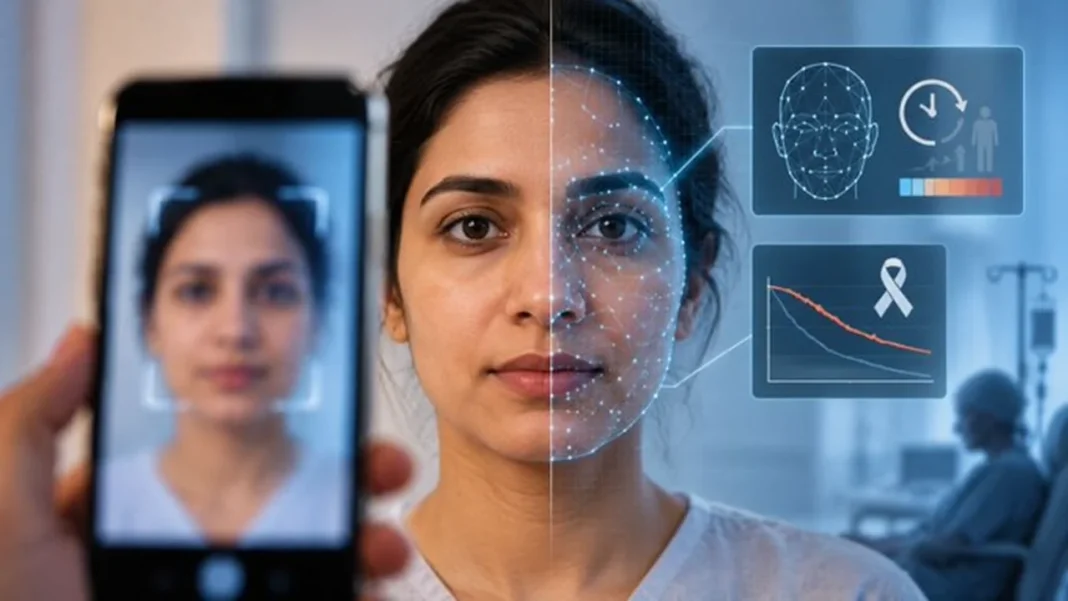

Could a photograph reveal more about someone’s health than their date of birth? Research published in October 2026 suggests facial images hold clues about ageing and cancer survival, although they cannot diagnose disease or tell anyone how long they will live.
Researchers at Mass General Brigham in the United States developed FAHR-Face, an artificial intelligence system trained on more than 40 million facial photographs. Published in The Lancet Digital Health, the study examined two separate predictions: apparent biological age and mortality risk in people already diagnosed with cancer.
Key Highlights
- FAHR-Face searches photographs for age-related and illness-related facial patterns.
- Its age model recorded an average error of 5.1 years on a public benchmark.
- Cancer patients in the highest predicted-risk group had over three times the mortality hazard of those in the lowest group.
- The technology remains a research tool, not a routine clinical test.
What Is Biological Age, and How Does It Differ From Actual Age?
A person turning 60 has a chronological age of 60. That figure does not change with their fitness or medical history. Biological age, by comparison, describes the body’s condition or pace of ageing, which scientists try to estimate using measurable indicators.
There is no single universally accepted biological-age test. Blood proteins and organ function may offer different estimates. A facial prediction is narrower: it identifies visible patterns associated with health outcomes in a studied population, without examining internal organs.
Someone whose facial age reads 65 at a chronological age of 60 has not necessarily aged five extra years internally. It is a model estimate, not a medical finding on its own.
How Does AI Read Biological Age From a Facial Photograph?
The Mass General Brigham announcement describes a foundation model trained on millions of faces, then adapted using more specialised datasets.
Two applications emerge from that work:
- FAHR-FaceAge estimates age in years, looking particularly at the forehead, temples and folds extending from the nose towards the mouth.
- FAHR-FaceSurvival estimates relative mortality risk among cancer patients, drawing more heavily on areas below the eyes and around the nasal bridge.
The software does not simply count wrinkles. Attention maps identify which regions influence its answer, but not the biological processes responsible.
In testing, different lighting, expressions, and makeup produced relatively consistent age estimates. Smoking showed the strongest association with looking older among lifestyle factors examined. An association, however, cannot establish any individual’s habits from a photograph.
What Did the October 2026 Study Find About Cancer Survival?
The survival algorithm was adapted using 34,363 photographs from cancer patients. The Lancet Digital Health study also tested the models in independent clinical datasets, rather than relying only on the images used in development.
The most striking result requires context. Patients in the highest FAHR-FaceSurvival risk quarter had 3.23 times the mortality hazard of those in the lowest quarter, even after adjustments for clinical factors. This compares groups; it does not forecast when a particular patient will die.
The Boston Globe’s report described another finding: cancer patients whose facial age exceeded their chronological age by at least five years had a 21% higher mortality risk after accounting for other factors.
The age tool’s 5.1-year average error refers to an age-estimation benchmark, not the accuracy of individual cancer forecasts. Using both models together improved prediction in independent patient data, although neither replaces a clinician’s assessment.
Can Facial AI Become a Regular Health Screening Test?
Not yet. The evidence comes largely from past cancer records. Researchers have not shown that face scans reliably detect hidden cancer, heart disease or remaining lifespan in healthy people.
Three boundaries are worth keeping in view:
- Medical decisions: Examinations, established tests and assessments of frailty remain necessary before intensive treatment.
- Privacy and fairness: Facial photographs are sensitive data. Broader testing across populations is needed to assess performance fairly.
- Personal predictions: A risk score is a statistical association, not a diagnosis or a reason to alter prescribed medication.
The team has opened a FaceAge Research Study to the public. Its results are intended for research rather than diagnosis, and anyone uploading images should read the consent information first.
For now, the important question is whether future clinical trials show that adding a facial score to established examinations improves care, not whether an online selfie produces an alarming number.
FAQs
Can AI determine biological age from my selfie?
AI estimates facial age from photographs, but that number is not a direct measure of internal ageing. Image quality and the population used for training affect reliability.
Does looking older mean somebody has cancer?
No. The 2026 research studied survival patterns among people with established cancer diagnoses. It did not demonstrate that older-looking faces indicate a previously undiagnosed tumour.
How accurate is the FAHR-FaceAge model?
On a public benchmark, its mean absolute error was 5.1 years. This describes facial age estimation, not the accuracy of predictions about an individual’s health.
Can facial AI predict how long patients live?
It separated cancer patients into statistical risk groups within research datasets. It cannot supply a dependable death date or replace a prognosis based on clinical findings.
Is the FaceAge tool available to the public?
Yes, through a research participation website. Uploaded facial images contribute to ongoing investigation; the age readout does not constitute a diagnosis or a medical clearance.
Key Questions on AI, Health Screenings and Cancer Care
1. Can AI Replace Regular Health Screenings?
No. AI may estimate biological age from facial photographs, but it cannot replace medical tests.
2. Can mRNA Vaccines Improve Cancer Treatment?
3. How Is Traditional Medicine Addressing Cancer?
4. Why Is Cancer Drug Access Important?
Access to affordable cancer medicines affects patients’ treatment options and continuity of care.
5. What Health Risks Can Screenings Detect?