

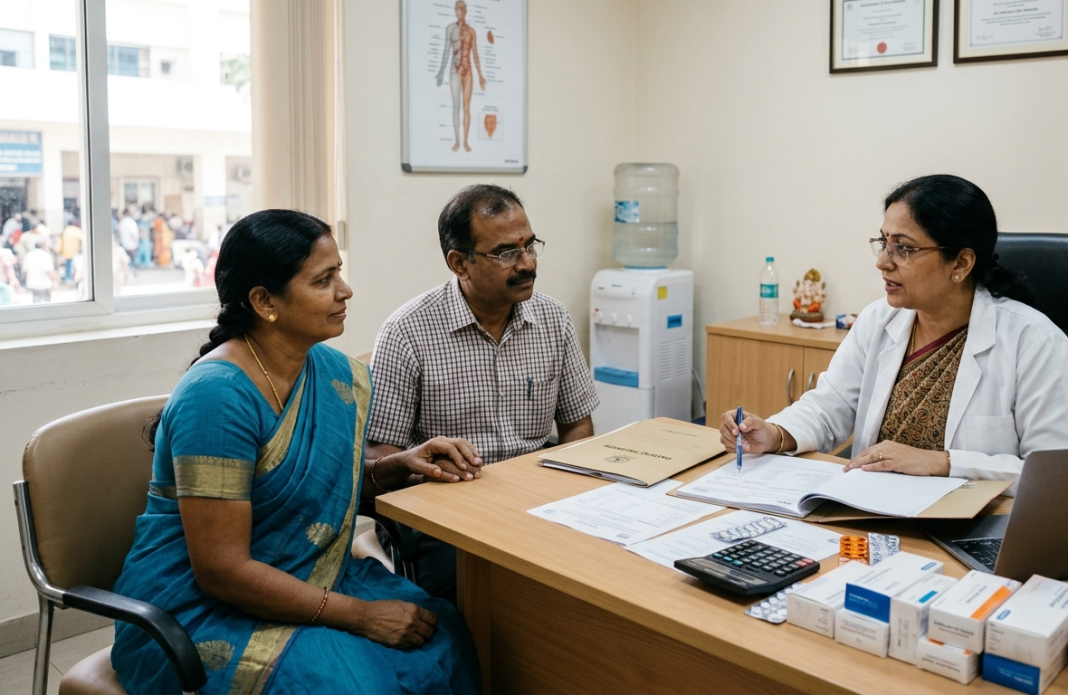

A breast cancer patient went to court because the medicine prescribed to her was beyond her reach. She died before the case reached a final decision. Years later, one question remained: what happens when a treatment exists, but its price shuts patients out?
On July 17, 2026, the Supreme Court stepped in. A Bench led by Chief Justice of India Surya Kant said it would examine affordable access to life-saving cancer medicines across India, along with judicial delays in urgent health cases. The move has returned drug patents, government powers and the right to health to national focus.
Why Did The Supreme Court Step Into The Cancer Drug Case?
The case began in 2022 when Kerala breast cancer patient Saroja Radhakrishnan approached the Kerala High Court. She said Ribociclib, a patented targeted therapy, was too expensive and unavailable at an affordable rate. According to a Hindustan Times report on the Supreme Court hearing, the medicine cost around ₹58,000 per month when the petition was filed.
Radhakrishnan argued that unaffordable treatment affected her right to health under Article 21. She later died, but the Kerala High Court continued the case as a suo motu public interest proceeding. The matter was listed for final hearing 57 times from January 21, 2023, without a final outcome.
The Supreme Court issued notice to the Centre and asked the Chief Justice of the Kerala High Court to ensure an early decision. It also indicated that the issue may require a pan-India approach, rather than relief limited to one patient or state.
The New Indian Express official Instagram post also shared the Court’s intervention on access to life-saving medicines.
Why Are Life-Saving Cancer Drugs In India Still So Expensive?
Ribociclib is a CDK4/6 inhibitor used for certain HR-positive, HER2-negative breast cancers. Such targeted medicines can slow cancer growth, but patent protection may prevent generic manufacturers from immediately selling cheaper versions.
For families, the bill does not end with one tablet strip. Tests, hospital visits, scans, supportive medicines, travel and lost wages keep adding up. A monthly drug cost running into tens of thousands of rupees can quickly exhaust savings.
Several factors keep advanced cancer treatment costly:
- Patented medicines may face little low-cost competition during the patent term.
- Treatment often continues for several months or longer.
- Insurance policies may carry limits, exclusions or co-payment conditions.
- Public hospitals can offer lower prices, though availability differs by location.
- Import costs, distribution margins and supply shortages can push bills higher.
This is why affordable cancer drugs cannot be treated only as a pricing debate. Delayed treatment may allow disease progression, while interrupted treatment can weaken the care plan recommended by doctors.
Can Patent Law And Recent Government Steps Lower Prices?
India’s Patents Act gives the government routes to respond when patented medicines remain out of reach. A compulsory licence can permit another manufacturer to produce a patented drug under stated conditions and royalty payments. Government-use provisions can also support public access in specific circumstances.
Senior advocate Anand Grover told the Supreme Court that compulsory licensing had been used only once since India restored pharmaceutical product patents in 2005. That reference points to the 2012 licence for sorafenib, a cancer medicine, a landmark use of patent law for public access.
Recent policy moves show the pricing challenge has many sides. The Union Budget 2026-27 customs relief exempted 17 cancer drugs from basic customs duty. That may reduce the landed cost of imported medicines, though removing duty does not erase a high patent-linked base price.
Availability can pull policy in the opposite direction. In June 2026, India’s drug price regulator raised ceiling prices for cisplatin and carboplatin by 50% after shortages and rising platinum costs. The Reuters report on the oncology drug shortage showed why a medicine must be both affordable and available. A low official price offers little help when hospitals cannot procure the drug.
What Could The Supreme Court’s Review Change For Patients?
The Supreme Court has not ordered a price cut or directed generic production. Its next steps could shape how governments, courts and regulators handle urgent medicine-access disputes.
The Court may examine whether health petitions involving life-threatening conditions need faster listing rules. It could also ask the Centre to explain how it decides when compulsory licensing, government procurement, negotiated pricing or patient-assistance programmes should be used.
A wider ruling may push authorities to publish transparent criteria instead of taking decisions case by case. Patients need predictable access before their condition worsens, not relief that arrives after years of hearings.
Frequently Asked Questions
Why Did The Supreme Court Take Up The Cancer Drug Issue?
It acted after prolonged hearings raised concerns about affordable treatment and delays affecting ill patients.
Which Cancer Medicine Was Central To The Kerala Case?
Ribociclib, a patented targeted therapy used for certain hormone-positive breast cancers, was central to proceedings.
Did The Supreme Court Reduce The Price Of Ribociclib?
No, the Court has begun examining broader access issues and has not ordered price reduction.
What Is A Compulsory Licence For Medicines?
It permits authorised production of a patented medicine, subject to conditions and royalty payment requirements.
Will Customs Duty Exemption Make Cancer Drugs Cheap?
It can lower import costs, but patents, base prices and distribution expenses may remain barriers.