
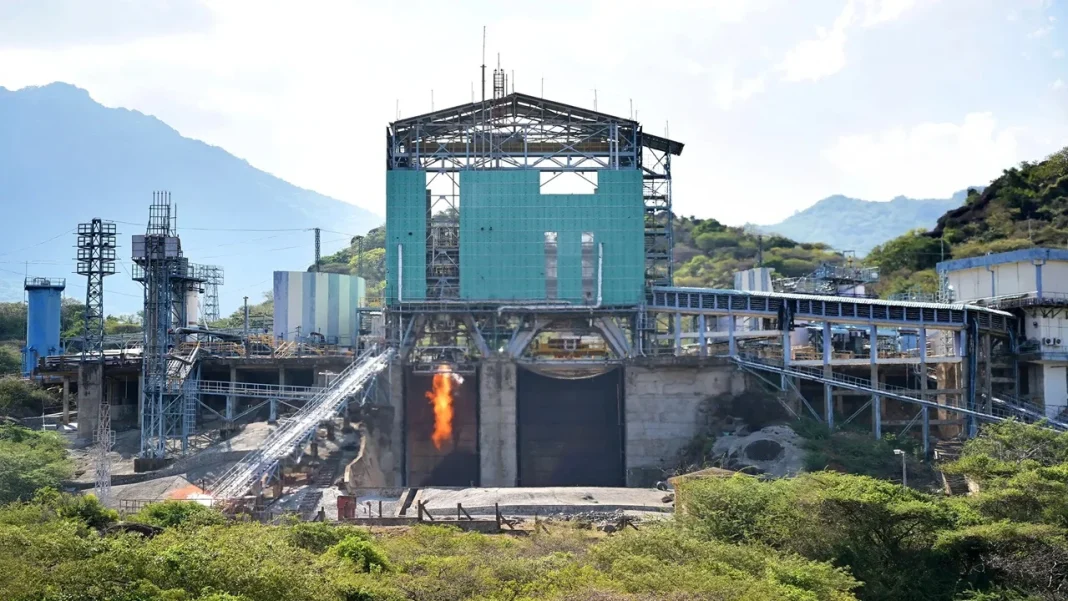

India’s Gaganyaan programme has entered another demanding stretch of qualification work before astronauts can be cleared for an Indian orbital flight. On September 9, 2026, ISRO tested a CE20 cryogenic engine at 22-tonne thrust and also demonstrated a liquid-oxygen tank pressurisation module intended for Gaganyaan’s C32 upper stages. ISRO’s September 10 CE20 test update
At the same time, work continues on the TV-D2 abort test and the first uncrewed Gaganyaan mission, G1, targeted for the fourth quarter of 2026 with Vyommitra onboard. The government says two more uncrewed flights are planned before the first crewed mission targeted in 2027.
Key Highlights
- ISRO is preparing TV-D2 while parallel qualification tests continue across Gaganyaan systems.
- G1 with Vyommitra is officially targeted for Q4 2026.
- Two further uncrewed missions are planned before India’s first crewed Gaganyaan flight.
- Recent tests covered parachutes, capsule uprighting, structural loads and upper-stage pressurisation hardware.
Why Gaganyaan Is Back in the Test Spotlight
The newest hardware update came from ISRO’s September 10 note on the CE20 test at Mahendragiri. The engine itself is earmarked for the LVM3-M7 operational mission, but the same test successfully demonstrated the LOX Tank Pressurisation Module meant for C32 stages for Gaganyaan. That connects a flight-acceptance exercise with India’s human-spaceflight hardware pipeline.
The wider programme has already crossed several major ground milestones. The Department of Space’s August Gaganyaan update says development and ground testing of all HLVM3 propulsion stages and structures are complete. Crew Module and Service Module propulsion systems have also been developed, tested and qualified, while all five Crew Escape System motor types have completed static testing.
What Still Has to Work Before Astronauts Fly
Human spaceflight requires proof that systems keep working when a flight leaves its planned path. That is why TV-D2 remains a major checkpoint. TV-D1 validated an in-flight Crew Escape System demonstration, while preparations for TV-D2 are now underway.
Descent is another demanding area. In April, IADT-02 dropped a roughly 5.7-tonne simulated Crew Module from an Indian Air Force Chinook at about three kilometres. Ten parachutes of four types deployed before splashdown and Navy-led recovery.
In July, ISRO completed its fifth Integrated Main Parachute Airdrop Test, exposing a main parachute to maximum expected loads for G1. Separate qualification work covered the capsule uprighting float system, Crew Module-Service Module umbilical separation, and structural loads during apex-cover separation.
Another July development widened ISRO’s testing options. The agency ground-fired the SOLVE sub-orbital test vehicle motor, designed to take Crew Module test articles to roughly 10–17 kilometres for further integrated parachute trials under different descent conditions.
G1 and Vyommitra Will Be the Biggest Pre-Crew Check
The first uncrewed orbital mission moves testing from individual components to an end-to-end flight. According to the government’s roadmap, G1 is targeted for Q4 2026 and will carry Vyommitra, the half-humanoid intended to support validation of technologies flying under the programme.
The mission must show that HLVM3, the orbital module, avionics, thermal protection, propulsion, communications, re-entry sequence, parachutes and recovery chain can operate together. The Environmental Control and Life Support System engineering model has been realised, but crew clearance will require integrated qualification, reviews and flight evidence.
Gaganyaan will also draw from Shubhanshu Shukla’s Axiom-4 experience. ISRO said its mission team worked alongside NASA and Axiom controllers on telemetry, crew schedules, health monitoring and emergency procedures during the 2025 ISS mission. ISRO’s Axiom-4 mission report
Why the 2027 Crewed Target Still Depends on Test Results
The official sequence places safety reviews ahead of the calendar. G1 comes first, followed by two additional uncrewed missions configured like the first crewed flight. Only after those flights and remaining qualification work receive clearance can Indian astronauts move towards launch.
That explains why parachute deployments, abort sequences and recovery drills receive so much scrutiny. Gaganyaan is not simply about reaching orbit. India must prove that astronauts can escape a failing launcher, survive re-entry, splash down safely and be recovered quickly.
Five Quick FAQs
What is Gaganyaan’s main goal?
Gaganyaan will demonstrate India’s capability to launch astronauts into orbit and bring them home safely.
Why is TV-D2 important?
TV-D2 will test the Crew Escape System during an in-flight abort scenario before crewed missions.
What will Vyommitra do?
Vyommitra will fly on the first uncrewed mission to help validate cabin systems before astronauts.
When is G1 targeted?
ISRO targets the first uncrewed Gaganyaan flight for fourth quarter 2026, subject to readiness reviews.
When could Indian astronauts fly?
India’s first crewed Gaganyaan mission is targeted for 2027 after three planned uncrewed orbital flights.
India’s Space Ambitions Are Reaching New Heights
When Will India Build Its Space Station?
Check out India’s 2035 space station plans and human spaceflight ambitions.
Can GalaxEye See Through Cloud Cover?
Find out how GalaxEye’s dual-sensor technology could improve satellite imaging.
Will Private Firms Reshape ISRO’s Future?
Uncover how private-sector expansion could change rocket and satellite manufacturing.
Could ISRO’s New Engine Lift More?
Explore how the 200-tonne thrust test could boost LVM3’s capabilities.
When Will India’s Space Station Launch?
Dive into the timeline for the first Bharatiya Antariksha Station module.