

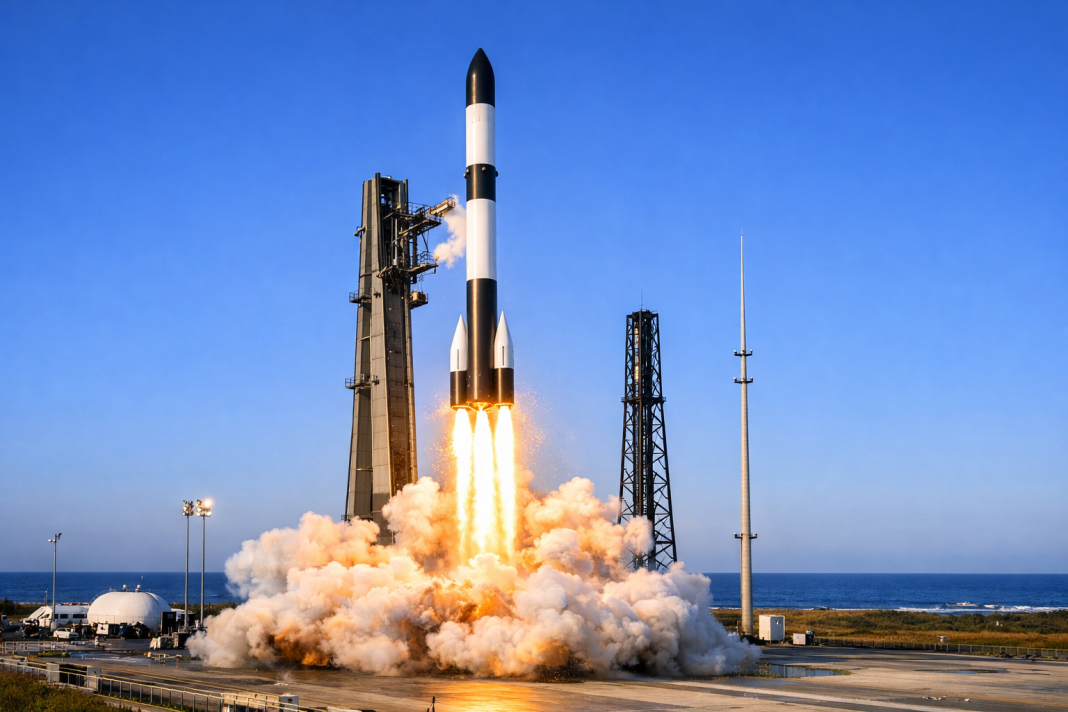

India’s space story is preparing for a rare handover moment. At 11:30 AM IST on July 18, 2026, Hyderabad-based Skyroot Aerospace is scheduled to send Vikram-1 from the First Launch Pad at the Satish Dhawan Space Centre in Sriharikota. Mission Aagaman is the first orbital attempt by a launch vehicle designed and developed by an Indian private company.
The date carries history. Exactly 46 years ago, on July 18, 1980, ISRO’s SLV-3 placed the Rohini satellite into orbit from Sriharikota. Today’s flight shows how India has moved from a state-led programme towards an industry where startups can build rockets and sell launches worldwide.
What Is Happening At Sriharikota Today?
Vikram-1 is due to lift off under Mission Aagaman, meaning “arrival”. It will attempt to carry Indian and international technology payloads to a 450-kilometre low Earth orbit at a 60-degree inclination. Skyroot confirmed the timing through its official Vikram-1 launch announcement on X.
Prime Minister Narendra Modi called the mission a historic new frontier and invited citizens to follow it. His official X message for Team Skyroot described Vikram-1 as a rapid, on-demand launch vehicle linked to India’s space reforms.
Key launch details include:
- Launch date: July 18, 2026
- Scheduled time: 11:30 AM IST
- Launch site: First Launch Pad, SDSC-SHAR, Sriharikota
- Target: 450 km low Earth orbit at 60-degree inclination
- Mission type: First Vikram-1 orbital development flight
Weather, range safety, or technical readings can still stop a rocket during the countdown. Until controllers confirm liftoff and payload deployment, Vikram-1 remains an orbital attempt rather than a completed success.
What Makes Vikram-1 Different From Earlier Private Rockets?
India has already seen a privately developed rocket fly. Skyroot’s Vikram-S reached about 89.5 kilometres during Mission Prarambh on November 18, 2022. However, that was a suborbital demonstration. It entered space and returned without achieving the sideways speed needed to remain around Earth. ISRO’s Mission Prarambh record confirms that it was India’s first privately built launch vehicle flight.
Vikram-1 takes a harder step. The seven-storey rocket must cross the atmosphere, separate stages at exact moments and accelerate payloads to orbital velocity. Its three lower stages use solid propulsion, while the liquid-fuelled upper stage can restart for precise satellite deployment.
According to Skyroot’s Vikram-I specifications, the rocket uses an all-carbon-composite structure, solid-fuel boosters, and a 3D-printed liquid engine. Its design can carry up to 350 kg to low Earth orbit or 260 kg to sun-synchronous orbit. This places Vikram-1 in the small-satellite segment, where customers often seek chosen launch dates and orbital paths rather than spare room on larger rockets.
ISRO also tested the Kalam-1200 first-stage motor at Sriharikota in August 2025. The 11-metre motor contained about 30 tonnes of propellant, giving engineers important ground data before today’s flight.
Why Could This Launch Change India’s Space Business?
The biggest story is the business model behind the rocket. A successful flight would show that an Indian startup can handle design, manufacturing, testing, authorisation, launch integration and orbital delivery. That record could draw overseas satellite firms towards India for commercial missions.
Small satellites support Earth observation, communications, climate monitoring, and in-orbit servicing. Many operators do not need a heavy rocket. They need a ride, leaving on a suitable date for the required orbit. Skyroot compares this dedicated approach to booking a cab instead of taking a train.
Mission Aagaman reflects that customer mix. The manifest includes Skyroot’s SCOPE satellite, Grahaa Space’s SOLARAS S3, a DCUBED technology demonstration, and Cosmoserve Space’s Embrace robotic arm for orbital-debris work. Symbolic cargo includes Cosmic Bloom, a space-bound artwork, and a miniature gold rocket honouring Vikram Sarabhai, C.V. Raman, and A.P.J. Abdul Kalam. The rocket will also carry a handwritten “Vande Mataram” postcard from Prime Minister Modi.
The flight also tests India’s policy shift. IN-SPACe was created in 2020 to authorise and support non-government space activity, while the Indian Space Policy 2023 widened private participation. Vikram-1 is where those reforms meet a live launch pad.
What Happens After Mission Aagaman?
Aagaman is the first of three planned development flights. Even a successful launch will not create a high-frequency commercial service overnight. Engineers will examine telemetry from propulsion, guidance, separation, thermal protection, and the upper-stage burn. Unexpected readings may lead to changes before the next mission.
The commercial test comes later. Skyroot has discussed producing up to one orbital rocket each month from Hyderabad, but that target depends on repeat flights, reliable manufacturing, and paying customers. India’s larger test is whether private launches become repeatable, affordable and trusted.
Frequently Asked Questions
What time is the Vikram-1 launch today?
Vikram-1 launches at 11:30 AM IST from Sriharikota on July 18, 2026, as scheduled.
Who developed the Vikram-1 rocket?
Skyroot Aerospace developed Vikram-1, India’s first privately built rocket designed to place satellites into orbit.
Which orbit will Mission Aagaman target?
Mission Aagaman targets a 450-kilometre low Earth orbit inclined at 60 degrees to Earth’s equator.
How much payload can Vikram-1 carry?
Vikram-1 can carry up to 350 kilograms to low Earth orbit, according to Skyroot Aerospace.
Why is the Vikram-1 launch important?
A successful flight would prove the privately developed Indian orbital launch technology and support commercial missions.