

India’s first bullet train has hit another headline before carrying its first passenger. The estimated cost of the 508-km Mumbai-Ahmedabad High-Speed Rail corridor has reportedly risen to around ₹2.1 lakh crore, almost twice the ₹1.08 lakh crore sanctioned in 2017. A proposal for the revised estimate was placed before the Union Cabinet on August 25, 2026, although no formal Cabinet briefing confirming approval had been issued when reports emerged.
The jump is not tied to one bill. Years lost to land acquisition, delayed train procurement, statutory approvals and a longer construction cycle have pushed the project far beyond its original budget.
How Much Has The Mumbai-Ahmedabad Bullet Train Cost Increased?
The original government estimate was ₹1.08 lakh crore. In January 2026, Railway Board Chairman Satish Kumar said the second revised estimate was expected to be about ₹1.98 lakh crore. By August, reports put it at around ₹2.1 lakh crore.
That means the project may require roughly ₹1 lakh crore more than originally planned. Most of the additional requirement is expected to come through budgetary support.
Key figures now being watched include:
- Revised estimate: around ₹2.1 lakh crore
- Original sanctioned cost: ₹1.08 lakh crore
- Corridor length: 508 km
- Stations planned: 12
- First operational stretch target: August 2027
- Full corridor completion expected: 2030
The financing was a major selling point from the start. Japan agreed to fund about 81% through a 50-year soft loan carrying 0.1% annual interest and a 15-year grace period. The 2017 government plan had also targeted commissioning in 2022-23, showing just how far the schedule has slipped.
Why Did The Bullet Train Project Become So Expensive?
The biggest problem was time. Land acquisition in Maharashtra moved far slower than planned and affected the project until 2021. The Railway Ministry’s 2026 project update confirmed that acquisition picked up in 2022. The full 1,389.5 hectares needed for the corridor has now been acquired.
A delayed mega-project keeps spending before trains start running. Contractors stay mobilised, material and labour prices change, engineering packages get rescheduled, and project overheads continue. Statutory clearances and utility shifting also took time. All 1,651 utilities have now been shifted, according to the government.
Train procurement became another sticking point. Reports on the revised estimate cite delays in getting train sets from Japan and the time taken to finalise rolling stock. The plan has changed too. India expects to start the first section with the locally developed B28 high-speed train, while Japan’s next-generation E10 Shinkansen is expected later.
That shift adds a Make in India chapter, but it also shows how much the rolling-stock plan has changed since the original estimate was prepared.
What Is Happening On The Ground In 2026?
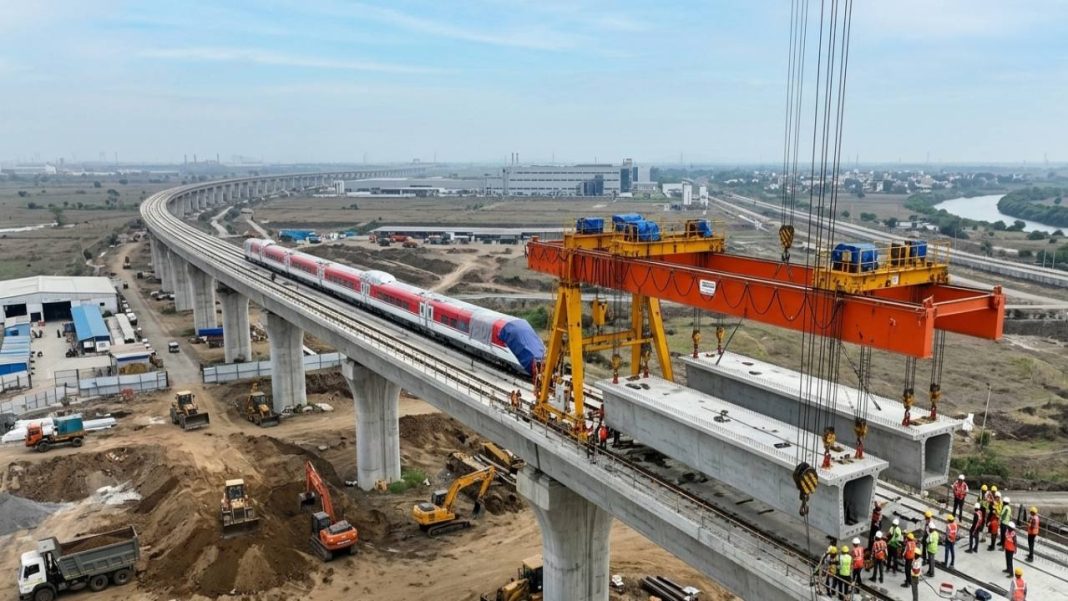
Despite the cost escalation, construction is well advanced. A July 2026 government progress update said 452 km of piers, 356 km of girders and 209 km of track bed had been completed. The corridor will have 12 stations from Mumbai to Sabarmati.
One of the hardest sections is the 21-km underground stretch in Maharashtra. It includes a 7-km undersea section beneath Thane Creek, India’s first undersea rail tunnel. Two large tunnel boring machines began excavation in July 2026.
The project has crossed other milestones too. All India Radio News highlighted the fifth mountain tunnel breakthrough on X in January 2026, showing how civil work continued while the budget debate grew.
The first passenger service is currently targeted for August 2027 on a limited section. Reports now place completion of the entire corridor in 2030.
Does The ₹2.1 Lakh Crore Estimate Change The Case For The Project?
The bigger bill will sharpen questions over value, fares, ridership and additional public funding. Yet this is also an unusually complex railway build involving long elevated stretches, tunnels, specialised slab track, signalling, stations and high-speed rolling stock.
Still, a near-doubling cannot be brushed aside. The revised estimate needs scrutiny because cheap Japanese financing was central to the original pitch. If much of the extra spending now comes from budgetary support, the financial burden changes.
The next test is whether the 2027 opening target holds, domestic train production stays on schedule and the complete corridor reaches 2030 without another major revision.
FAQs
What is the latest estimated cost of the Mumbai-Ahmedabad bullet train?
The revised estimated cost is around ₹2.1 lakh crore, pending government approval and confirmation.
What was the original cost of the bullet train project?
The Mumbai-Ahmedabad high-speed rail corridor was sanctioned at approximately ₹1.08 lakh crore in 2017.
Why has the bullet train cost increased so sharply?
Land delays, approvals, train procurement and longer construction periods contributed heavily to the rising costs.
When will the first bullet train section open?
The first operational section is targeted for August 2027, according to recent railway project reports.
When is the entire Mumbai-Ahmedabad bullet train expected to finish?
Current reports indicate the complete 508-km Mumbai-Ahmedabad high-speed rail corridor could be finished by 2030.