

India’s heaviest operational rocket could be heading for its biggest industrial shift yet. Larsen & Toubro, Adani Group, JSW, Mahindra and other Indian companies or consortiums are considering bids for the transfer of ISRO’s LVM3 technology, according to an Economic Times report published on August 31, 2026. The plan would allow the selected private player to manufacture, launch and commercially operate the heavy-lift vehicle after absorbing its end-to-end know-how.
The development comes as ISRO moves mature launch systems into industry while reserving more engineering capacity for Gaganyaan, deep-space missions and future launch technologies. LVM3 already carries strong commercial credentials, including OneWeb missions and the December 2025 BlueBird Block-2 launch.
Key Highlights
- L&T, Adani, Mahindra and JSW-linked groups are among the reported interested parties.
- JSW is reportedly exploring the opportunity with space startup Ethereal Exploration Guild, or EtherealX.
- Solar Industries, Bharat Forge and Inox India are also linked to interested groups.
- The selected bidder could receive end-to-end LVM3 technology for manufacturing and commercial operations.
- Technology absorption is expected to run for up to 42 months or two realised LVM3 vehicles.
- Formal bidding is reported to be expected in October 2026 after the EOI stage.
Which Companies Are Looking At ISRO’s LVM3 Technology?
The current race is broader than a contest among traditional aerospace manufacturers. Economic Times reported that at least half a dozen Indian companies or consortiums are considering expressions of interest. Besides L&T, Adani Group and Mahindra, the list includes a JSW-EtherealX alliance and groups involving Solar Industries, Bharat Forge and Inox India.
That mix is noteworthy because each company brings a different industrial strength. L&T has launch-vehicle manufacturing experience through its work with HAL on PSLV. Solar Industries has capabilities in solid rocket motors and propellants. Bharat Forge works in precision engineering and aerospace components, while Inox India makes cryogenic and propellant-handling equipment.
An EOI is not a final bid. Companies can study the technical obligations, capital needed and commercial opportunity before joining the next round.
Why Is The ‘Bahubali’ Launcher Such A Valuable Prize?
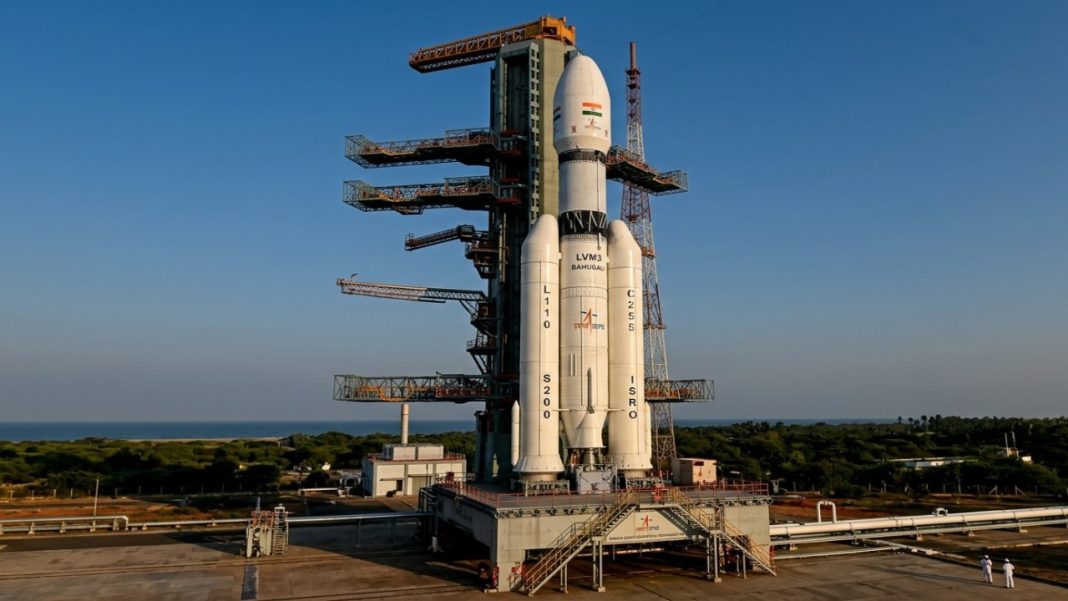
LVM3 is not an experimental vehicle waiting for its first customer. ISRO’s official LVM3 specifications describe a three-stage launcher using two S200 solid strap-ons, an L110 liquid core stage and a C25 cryogenic upper stage. Its newer mission documentation lists a 4,200 kg payload capability to geosynchronous transfer orbit.
Its record gives prospective private operators something difficult to build quickly: flight heritage. LVM3 launched Chandrayaan-2 in 2019, flew two commercial OneWeb missions carrying 72 satellites in total, sent Chandrayaan-3 towards the Moon in 2023, and completed two more operational flights in 2025.
The December 24, 2025 LVM3-M6 BlueBird Block-2 mission placed AST SpaceMobile’s satellite into orbit. The government later said the 6,100 kg payload was the heaviest launched by LVM3 from Indian soil. That mission strengthened the launcher’s commercial story before the latest technology-transfer push.
How Could The LVM3 Technology Transfer Work?
The winning company or consortium would be expected to absorb far more than assembly instructions. The EOI reviewed by Economic Times covers design, propulsion, avionics, navigation, manufacturing, testing, integration and launch operations.
The reported transfer period is 42 months or two realised launch vehicles. During that phase, the private partner would work alongside ISRO and IN-SPACe before building infrastructure needed to manufacture LVM3 systems more independently.
IN-SPACe’s official social announcement had already invited eligible Indian private entities to pursue end-to-end realisation, operation and commercialisation of LVM3. Its post originally listed August 7, 2026 as the submission deadline; reporting on August 31 said EOIs were due that Monday, indicating the timetable had subsequently moved.
The final contest is expected to combine technical capability with price. Applicants must also present a business plan covering investment, launch demand and revenue.
Could Private Industry Soon Build India’s Heaviest Rocket?
Yes, but “soon” still means a staged handover rather than an immediate private launch. The selected player must first absorb a complex launch system, qualify manufacturing, build infrastructure and prove that quality controls match ISRO standards.
The direction is already clear. PSLV production has moved towards an industry-led model, while HAL signed the SSLV technology-transfer agreement in September 2025. Moving LVM3 deeper into private industry would leave three major operational launch families with substantial industrial participation.
For India, the larger goal is higher launch frequency and a stronger commercial pipeline. For private companies, LVM3 offers entry into high-value satellite launches without developing a heavy launcher from scratch. The harder test will come after selection: producing repeatable rockets, winning customers and maintaining mission reliability.
FAQs
1. What Is LVM3?
LVM3 is ISRO’s three-stage heavy-lift rocket used for lunar, commercial and high-capacity satellite missions today.
2. Which Companies Are Interested In LVM3 Technology?
L&T, Adani, JSW-linked groups, Mahindra, Solar Industries, Bharat Forge and Inox India are currently reported.
3. Can A Private Company Operate LVM3 Commercially?
Yes, the selected entity is expected to manufacture, launch and commercially operate the LVM3 vehicle.
4. How Long Could The Technology Transfer Take?
The transfer is expected to last 42 months or until two LVM3 vehicles are realised.
5. Why Is ISRO Moving Rockets To Private Industry?
The shift can expand commercial launches while ISRO concentrates on advanced missions and new technologies.