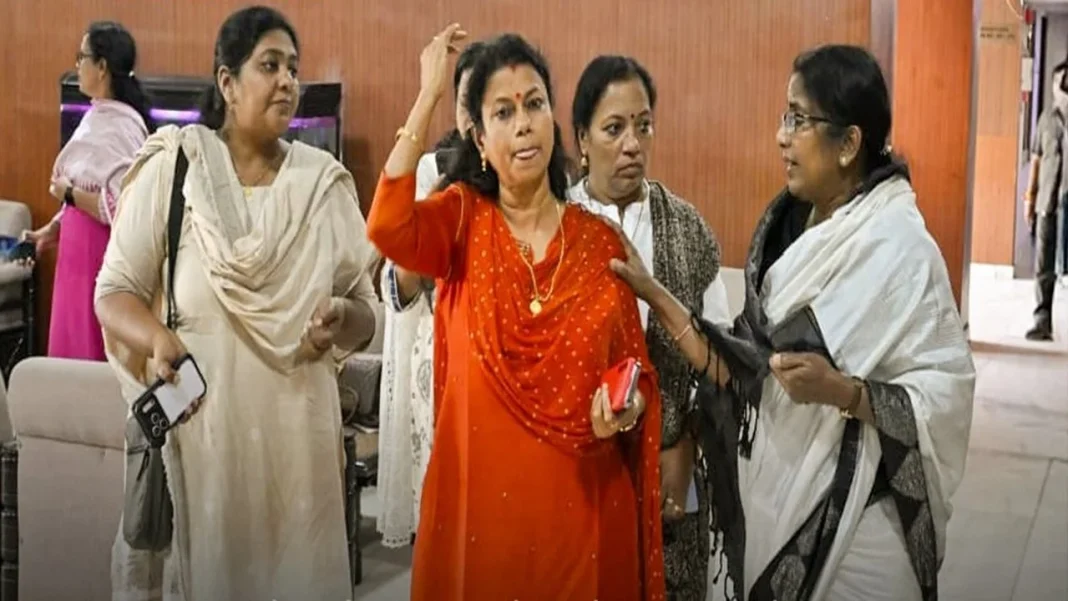

Eight women legislators from Kerala walked out of a National Commission for Women programme in Faridabad on September 8, 2026, after objecting to sessions conducted largely in Hindi without adequate translation or English support. The two-day “She Is a Changemaker” workshop was held on September 7 and 8 at Taj Surajkund and drew more than 100 women legislators. The dispute has reopened a wider question: when a Union-level institution invites representatives from different regions, should participants always have a non-Hindi option?
Key Highlights
- Kerala legislators said they requested English alongside Hindi but were unable to follow much of the programme.
- Their objections also covered limited interaction and content they considered too basic for elected lawmakers.
- Hindi is the Union’s official language, while English may continue for official Union purposes under law.
- The row comes amid wider 2026 disputes over language policy in Tamil Nadu, Karnataka and Maharashtra.
What Happened At The NCW Workshop In Faridabad?
The NCW organised the capacity-building programme under its “She Is a Changemaker” initiative. Lok Sabha Speaker Om Birla inaugurated the event. According to the Indian Express, more than 100 legislators attended.
Kerala Deputy Speaker Shanimol Osman and other delegates said Hindi dominated the sessions and that requests to mix in English were not accepted. Minister Bindhu Krishna said the group had not objected to Hindi itself. Their complaint, she said, was that a national programme had not created enough room for participants from non-Hindi-speaking states. India Today also reported that delegates questioned the programme’s content and lack of an open-house discussion.
The NCW had not issued an immediate response to the allegations in reports available after the walkout.
Why Did A Workshop Dispute Turn Into A National Language Row?
The row grew after Kerala legislators alleged that some participants described Hindi as India’s national language and insisted discussions would continue in Hindi. They also alleged that slogans were raised during the confrontation. Those claims came from the legislators, while NCW officials had not publicly answered them in the reports reviewed.
Political reaction followed quickly. Kerala Chief Minister V D Satheesan accused the organisers of Hindi imposition, while Congress MP Shashi Tharoor linked the episode to cooperative federalism. South First’s official news account also posted video and details from the dispute on X. South First’s X post on the NCW walkout
The timing added fuel. In April, Tamil Nadu and the Centre clashed over the CBSE three-language formula, with the Union government rejecting claims that Hindi was compulsory. In early September, groups from Maharashtra and Karnataka formed an “Indian Languages Forum” around language rights and opposition to alleged Hindi imposition.
What Do India’s Constitution And Official Language Rules Actually Say?
India’s legal framework does not declare Hindi the national language. Article 343 makes Hindi in Devanagari the official language of the Union. The government’s official language policy also states that English may be used for Union purposes. Government of India Official Language Policy
| Rule Or Provision | What It Says |
| Article 343 | Hindi in Devanagari is the Union’s official language. |
| Official Languages Act, 1963 | English may continue alongside Hindi for Union official purposes. |
| Union-State communication | English is required in specified communication with states that have not adopted Hindi officially. |
The Official Languages Act also requires both Hindi and English for several categories of Union documents and protects effective functioning by officials proficient in either language. Official Languages Act, 1963
That does not create a blanket legal rule requiring every government seminar, speech or workshop to offer simultaneous translation. The dispute is therefore partly about administration and inclusion, not only statutory compliance.
Should National Government Events Always Provide Non-Hindi Options?
For genuinely national events, the strongest case is for a usable fallback language or interpretation system whenever delegates come from different linguistic regions. English is already recognised for Union official work, making it a common option in formal settings. Large events can also use live interpretation, bilingual slides or advance language preferences.
What A Better National Event Could Look Like
Organisers could ask delegates for language needs during registration, provide Hindi-English interpretation where required, and add regional-language support when attendance justifies it. That would not reduce Hindi’s official role. It would prevent invited participants from sitting through sessions they cannot fully follow.
The Faridabad walkout shows why language planning can become political quickly. A national institution does not need one language for every participant. It needs a format in which every invited delegate can participate.
FAQs
Did Kerala women legislators walk out of the NCW programme?
Yes, eight legislators left after objecting to Hindi-heavy sessions and inadequate language support during proceedings.
Is Hindi India’s national language under the Constitution?
No. Hindi is the Union’s official language; the Constitution does not designate one national language.
Can English still be used for Union government work?
Yes. The Official Languages Act allows English to continue alongside Hindi for Union official purposes.
Did the NCW immediately respond to the Kerala legislators’ allegations?
No immediate NCW response was reported in coverage reviewed after the September 8 walkout publicly.
Should every national event provide English or translation?
Not by one blanket law, but nationwide participation supports accessible language options for invited delegates.
India’s Latest Highlights: Nutrition, Cricket, Education & Hockey
- What Will Poshan Maah 2026 Change?
Check out the new nutrition measures targeting women and children across India. - What Records Could Mandhana Break Next?
Find out which major women’s international cricket records Smriti Mandhana could challenge next. - How Did Deepti Rewrite T20I Records?
Uncover how Deepti Sharma’s remarkable spell made her women’s T20I cricket’s top wicket-taker. - How Will Bihar’s Women-Only University Work?
Browse the proposed Mahila Vishwavidyalaya and its women-led administrative structure. - How Did India Reach Hockey’s Heights?
See what changed as India Women secured their best Hockey World Cup finish in 52 years.