
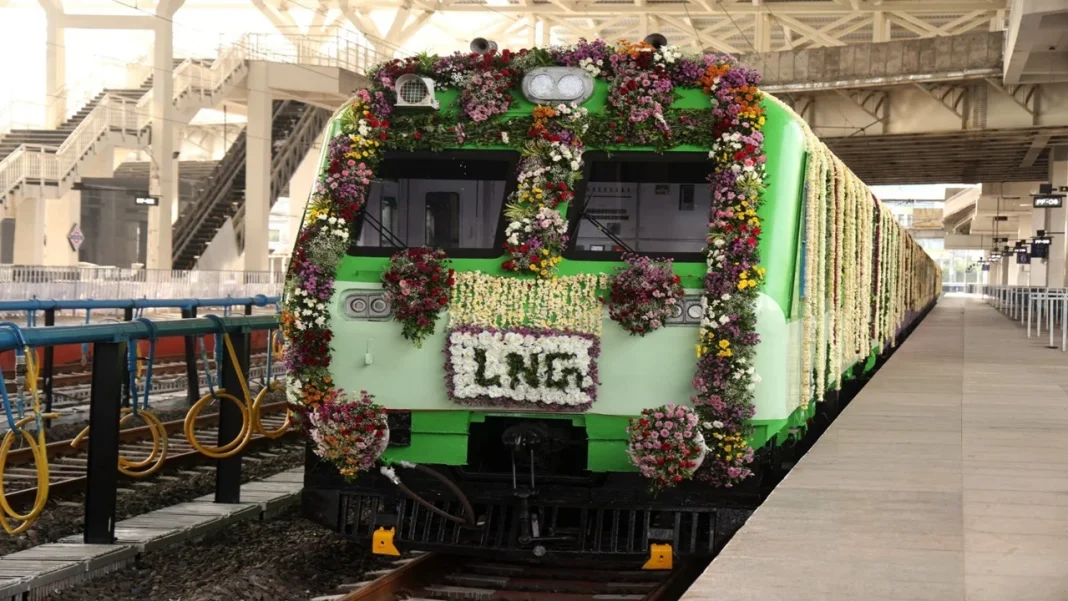

India has put two different alternative-fuel railway ideas on the tracks within just over two months. On 27 September 2026, the country’s first LNG-powered train was publicly flagged off from Sabarmati Railway Station in Ahmedabad, as confirmed in the official PIB release on the Sabarmati launch. It is an LNG-diesel dual-fuel DEMU, not a train running only on gas. India’s first hydrogen train, launched on 17 July between Jind and Sonipat, works differently: fuel cells make electricity onboard and the direct by-product is water vapour. The contrast shows Indian Railways testing both a diesel-saving option and a zero-tailpipe-carbon propulsion system. One modifies existing diesel technology; the other carries an onboard electrochemical power plant and needs dedicated hydrogen infrastructure.
Key Highlights
- The Sabarmati LNG-Diesel DEMU can replace roughly 40% of diesel with LNG.
- Its inaugural run linked Sabarmati and Mahesana; a permanent route was still to be finalised.
- India’s 10-coach hydrogen train uses fuel cells, batteries and pressurised green hydrogen.
- Railways says the LNG rake could save about ₹23.9 lakh in fuel costs each year.
What India’s First LNG-Diesel Train Actually Changes
The eight-coach, non-AC DEMU uses two converted 1,400 HP Driving Power Cars. Each DPC carries an LNG storage system of about 2,200 litres. Instead of replacing the diesel engine, the conversion lets LNG substitute part of the diesel being burned. Calling it simply an “LNG train” can therefore hide an important detail: diesel remains part of the propulsion system.
The train completed more than 2,000 km of field trials before the flag-off. Its inaugural journey ran on the roughly 62 km Sabarmati-Mahesana section; a regular route has not yet been announced. The Indian Express’s report on the LNG train gives trial-based yearly savings of ₹11.9 lakh per DPC and ₹23.9 lakh for an eight-coach rake.
The Ministry of Railways also documented the launch in its official X post from Sabarmati. The same Sabarmati programme also featured a WAG-12 maintenance shed and Kavach deployment.
How the LNG-Diesel Train Differs From India’s Hydrogen Train
The biggest difference sits inside the power system. The LNG-Diesel DEMU still relies on internal combustion. LNG, a fossil fuel made mainly of methane, is stored in liquid form and used alongside diesel. Burning it still produces carbon dioxide, though replacing some diesel can reduce fuel use and emissions such as CO₂, nitrogen oxides and particulate matter.
The hydrogen train does not burn hydrogen in an engine. Hydrogen stored onboard enters fuel cells, where it reacts with oxygen to make electricity. Supported by lithium iron phosphate batteries, that electricity powers the traction motors. According to the Ministry of Railways’ hydrogen train explainer, the direct by-products are water vapour and heat, with no smoke or tailpipe carbon emissions.
India’s hydrogen train has 10 coaches, including two 1,200 kW Hydrogen Driving Power Cars, giving 2,400 kW total power. Its initial Jind-Sonipat route is 89 km, with an operational speed of 75 kmph and a design speed of 110 kmph.
Why Railways Is Testing Two Cleaner Fuel Paths at Once
The two projects solve different problems. LNG offers a retrofit route for diesel equipment. Existing power cars can be modified while diesel remains available when required. For routes where diesel stock is still used, that offers a bridge toward lower fuel consumption.
Hydrogen needs much more infrastructure. The Jind project includes hydrogen production through electrolysis, compression, high-pressure storage and dedicated dispensers. PIB says hydrogen is stored at up to 500 bar and dispensed at 350 bar. The site can store nearly 3,000 kg, while the train carries leak, heat, flame and smoke detection systems.
That complexity comes with a cleaner point-of-use result. By 25 July, the hydrogen train had travelled more than 1,200 km and, according to the Railways, displaced over 3,200 litres of diesel. LNG, by comparison, is designed to reduce diesel use rather than eliminate combustion.
What Comes Next for India’s Alternative-Fuel Trains
The September launch does not mean LNG will replace electric trains across India. More than 99% of Broad Gauge routes are already electrified, according to the Railways. The more relevant question is where alternative fuels fit on routes or legacy fleets where diesel remains useful.
The LNG experiment will be watched for long-term reliability, refuelling needs, maintenance costs and actual fuel savings outside trial conditions. Hydrogen faces a different test: whether its specialised production and storage network can be expanded economically while maintaining strict safety controls.
For Indian Railways, these are parallel experiments rather than competing copies. LNG changes the fuel mix inside a familiar engine. Hydrogen changes the propulsion chain itself. Their future will depend on route economics, infrastructure and operating performance.
FAQs
Is India’s LNG train fully powered by LNG?
No. It uses LNG with diesel, allowing gas to replace part of normal diesel consumption.
When was India’s first hydrogen train launched?
It was officially flagged off on 17 July 2026 between Jind and Sonipat in Haryana.
Does the hydrogen train produce carbon emissions at the tailpipe?
No. Its fuel-cell reaction directly produces electricity, water vapour and heat instead of exhaust smoke.
How much diesel can the LNG-Diesel DEMU replace?
The converted system is designed to substitute roughly 40% of the diesel normally used onboard.
Has the LNG train’s permanent route been announced?
Not yet. Sabarmati-Mahesana hosted the inaugural run while Railways considers its future regular operating route.
India’s Railways Are Entering A New Era
Could LNG Trains Reduce Diesel Use?
Check out how LNG-powered trains could reduce railway diesel consumption.
How Fast Will New Trains Go?
Find out the speeds planned for India’s high-speed rail testing.
Why Is Tejas Getting A Brand?
Uncover why the Tejas Express is getting a unique branded identity.
What Makes India’s Hydrogen Train Special?
Explore the route, speed, and ticket details of India’s first hydrogen train.
Is Kavach 4.0 Transforming Railway Safety?
See how Kavach 4.0 is expanding automatic train protection across India.