

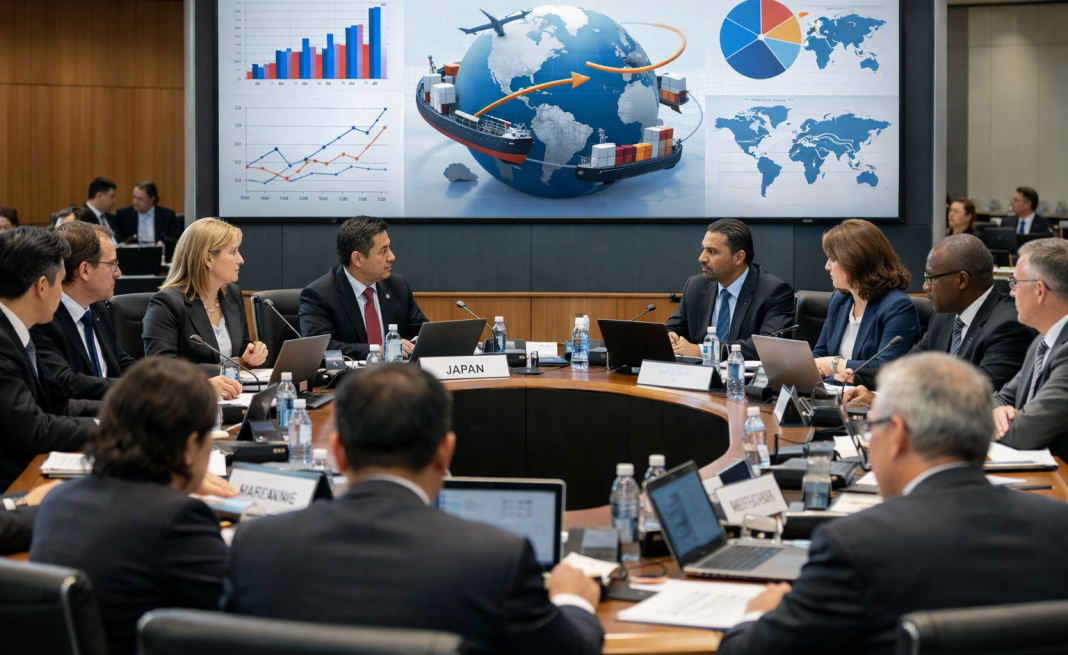

India’s trade rulebook is under a global spotlight as World Trade Organization members examine the country’s policies during its eighth Trade Policy Review. More than 900 written questions had reached New Delhi by July 20, 2026, before meetings scheduled in Geneva on July 21 and 23.
The number sounds confrontational, but this is not a trade dispute or punishment hearing. It is a scheduled peer review in which WTO members ask how tariffs, subsidies, regulations and customs systems affect international trade. India’s expanding economy, new trade agreements and manufacturing push have naturally drawn attention.
What Happened At India’s Eighth WTO Trade Review?
The Commerce Ministry’s official release says Commerce Secretary Rajesh Agarwal is leading India’s delegation. The review covers January 1, 2021, to December 31, 2025, a period shaped by pandemic recovery, supply-chain shocks, digital reforms and new free trade agreements.
India began preparing in June 2025. More than 100 ministries, departments and organisations contributed over 14 months. The government says merchandise and services exports reached a record $863.1 billion in 2025-26, compared with $676.5 billion in 2021-22. More than 40 WTO members are expected to make statements.
Key points from the review include:
- WTO members submitted over 900 questions seeking written replies from India.
- Meetings are being held on July 21 and July 23, 2026.
- Questions cover digitisation, MSMEs, women’s economic participation, Viksit Bharat and Atmanirbhar Bharat.
- India’s GST changes, UPI, trade facilitation and recent FTAs feature in the review documents.
- The process uses an Indian government report and an independent WTO Secretariat report.
The WTO’s official X post also listed India’s review among its main meetings for July 20-24.
Why Are Other Countries Asking India So Many Questions?
Every WTO member undergoes a Trade Policy Review. Larger trading economies are reviewed more often because their policies can affect exporters, investors and supply chains across several markets. India’s review takes place roughly once every five years.
Nine hundred questions do not mean 900 violations. One member may ask several detailed questions about separate products, schemes or procedures. Governments use the process to seek information companies may need before exporting, offering services or investing in India.
The official release has named broad themes, but it has not published the complete question-by-question list. Claims that every question attacks India’s tariffs, farming support or industrial policy would therefore go beyond available information.
Still, the response shows India’s policies now carry wider commercial consequences. Foreign governments want predictable rules when Indian standards, taxes, licensing decisions or incentives can alter market access.
Which Indian Trade Policies May Receive Closer Attention?
Atmanirbhar Bharat is likely to receive careful examination because it combines domestic manufacturing, government incentives and import-reduction goals. Members may ask whether individual measures treat imported and locally produced goods differently. Production-linked incentive schemes can also invite questions about eligibility, domestic value addition and export effects.
Tariffs remain a familiar topic. During India’s previous review, the government confirmed that the United States and European Union had questioned applied tariff rates and agricultural support programmes such as minimum support prices. India said those farm policies complied with WTO agriculture rules. The 2021 official response provides earlier context.
Quality Control Orders, import licensing, customs procedures, digital trade, data rules, public procurement and services regulation may attract interest because they can change market-entry costs. Such questions are not automatically accusations. Members may request timelines, legal explanations or implementation details.
A timely development sits beside the review. India deposited its acceptance of the WTO Agreement on Fisheries Subsidies on July 20. The pact limits subsidies linked to illegal fishing and overfished stocks, while India says small-scale fishers, aquaculture and inland fisheries remain protected. The move gave India a positive sustainability story as scrutiny began.
What Could The WTO Review Mean For India?
The review cannot directly impose fines, cancel an Indian policy or force an immediate tariff cut. Its main value is transparency. India can explain its development needs, food-security concerns, digital systems and manufacturing strategy. Trading partners receive formal replies they can examine later.
Sharp questions may still create diplomatic pressure. They can expose unclear rules, delayed notifications or policies businesses find difficult to navigate. India may defend some measures while simplifying others to support exports and investment.
The discussion will test India’s wider message. New Delhi wants recognition as a fast-growing market, manufacturing base and voice for developing economies. It must also show that domestic goals can operate alongside predictable multilateral trade rules.
FAQs
What is a WTO Trade Policy Review?
It is a regular peer review examining one member’s trade rules, reforms, practices and policies.
Why did India receive over 900 questions?
India’s growing market, policy changes and trade influence prompted detailed questions from many WTO members.
Does the review mean India broke WTO rules?
No, a Trade Policy Review promotes transparency and does not automatically establish any violation itself.
Which period does India’s eighth review cover?
It covers India’s official trade policy developments from January 1, 2021 through December 31, 2025.
Can the WTO order India to change policies?
Not through this review; binding rulings require a separate WTO dispute involving legal proceedings instead.