

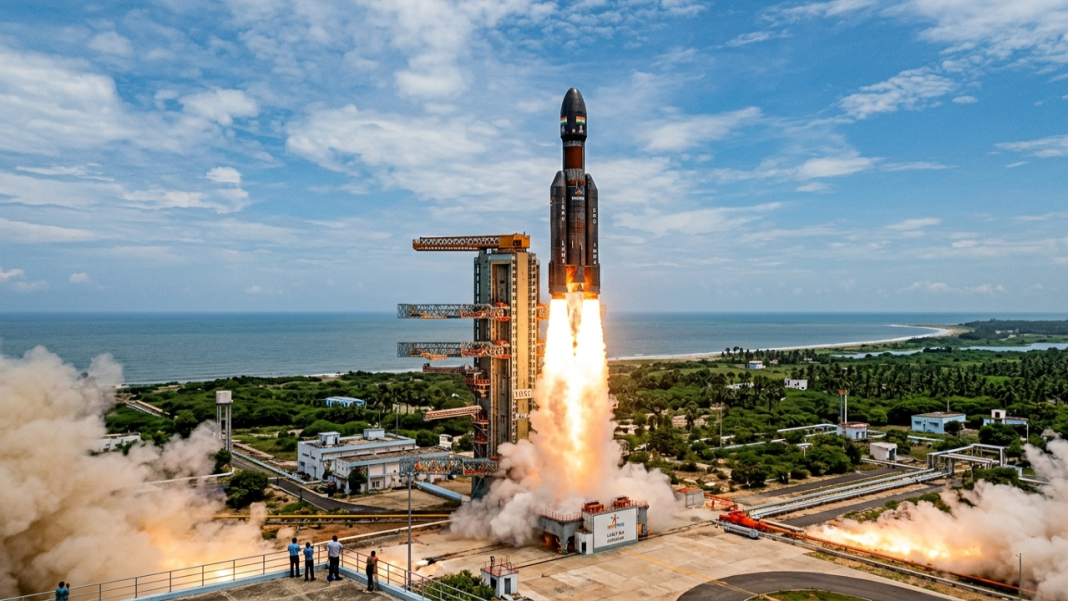

India’s launch pads at Sriharikota have been unusually still through most of 2026. That could change in September, with ISRO preparing GISAT-1A, also called EOS-05, for a GSLV Mk II flight. The mission is expected to end a launch gap stretching back to January 12, when PSLV-C62 ran into trouble during flight.
The pause has drawn attention because it followed two PSLV failures within eight months, while important satellites were already waiting for their turn. ISRO’s launch records show PSLV-C62 as the only launch from Sriharikota in 2026 so far. Reports on August 18 said GISAT-1A is being lined up for September, although ISRO has not announced a final launch date.
Why GISAT-1A Is The Mission Bringing ISRO Back
GISAT-1A is an Earth-observation satellite designed to watch the Indian subcontinent from geostationary orbit. Its value lies in repeated imaging of the same broad region, rather than waiting for a low-orbit satellite to pass overhead again.
That makes the spacecraft useful for fast-changing events. Expected applications include disaster monitoring, agriculture, forestry, environmental observation and national-security requirements. The satellite is also a replacement for EOS-03, or GISAT-1, which was lost during the GSLV-F10 mission on August 12, 2021. ISRO’s record of that mission confirms the cryogenic upper stage did not ignite as planned.
The upcoming flight therefore carries more than routine scheduling importance. It brings back a mission India has been trying to place in orbit for years, while also reopening an otherwise quiet launch calendar.
Key points around the return are:
- GISAT-1A is also known as EOS-05.
- A GSLV Mk II is expected to carry it from Sriharikota.
- Reports place the mission in September 2026, but ISRO has not announced the final date.
- The original GISAT-1 mission failed in 2021 after a cryogenic upper-stage problem.
Why Has India’s Launch Calendar Been Quiet Since January?
The immediate trigger was PSLV-C62. The rocket lifted off on January 12 carrying EOS-N1 and 15 co-passenger payloads. ISRO later said an anomaly occurred near the end of the PS3, or third-stage, portion of the flight and began a detailed analysis. Its official PSLV-C62 mission page still carries that update.
It was especially serious because PSLV-C61 had also failed on May 18, 2025. That earlier mission, carrying EOS-09, suffered a third-stage problem as well. Two failures involving the same broad stage of India’s workhorse launcher brought additional scrutiny before launch activity could regain pace.
On August 3, The Times of India reported that GISAT-1A and NVS-03 were already at Sriharikota but awaiting government approval. A GSLV Mk II was also reportedly prepared, with launch activity held back while authorities reviewed the situation.
This explains why “quiet since February” is slightly misleading. There was no February launch. India’s last rocket flight was actually PSLV-C62 on January 12, 2026.
What Went Wrong Before The Seven-Month Pause?
The January setback was not an isolated bad day. PSLV-C61 had failed eight months earlier after ISRO reported a pressure drop in its PS3 stage. Then PSLV-C62 encountered another anomaly toward the end of PS3.
A Reuters report on PSLV-C62 said the vehicle deviated from its path after performing normally for much of the flight. ISRO described the problem more briefly, saying analysis had been started.
The agency also addressed the failure publicly. In this official ISRO post on X, it said the anomaly occurred near the end of the PS3 stage and a detailed investigation had begun.
GISAT-1A itself has history behind it. Its predecessor EOS-03 failed in 2021 when the GSLV cryogenic upper stage could not operate normally. ISRO’s failure analysis later linked the loss to low liquid-hydrogen tank pressure caused by leakage involving a vent and relief valve. Corrective work followed.
So the September return is not simply about filling an empty calendar. It comes after technical reviews, launch-clearance questions and a difficult run that put reliability back under the spotlight.
What Comes After GISAT-1A?
A successful GISAT-1A flight could ease some pressure around India’s delayed launch queue, but several missions remain important. NVS-03 is intended to strengthen the second-generation NavIC constellation, while ISRO continues work on Gaganyaan-related flights and other satellite missions.
The recent record explains the caution. India had six launches from Sriharikota across 2025 and January 2026. PSLV-C61 failed, NVS-02 could not reach its intended operational orbit after a spacecraft propulsion problem, and PSLV-C62 failed to place its payloads as planned.
GISAT-1A now offers ISRO a clean restart opportunity. The bigger test comes afterwards: whether missions begin leaving Sriharikota regularly again, and whether the agency can rebuild momentum without rushing past the lessons of two difficult PSLV flights.
FAQs
When Is GISAT-1A Expected To Launch?
Reports point to September 2026, although ISRO has not announced the final launch date publicly.
What Rocket Will Carry GISAT-1A?
GISAT-1A is expected to fly aboard India’s GSLV Mk II from Sriharikota spaceport in Andhra.
Why Did PSLV-C62 Fail?
ISRO reported an anomaly near the end of the rocket’s PS3 stage and opened analysis
What Will GISAT-1A Do?
It will provide frequent Earth imagery for disasters, agriculture, forestry, environmental monitoring and applications nationwide.
Was There An ISRO Launch In February 2026?
No. ISRO’s latest 2026 launch was PSLV-C62 on January 12, before the operational pause began.
Stay updated on ISRO missions, satellite launches, space technology and the latest developments shaping India’s space programme.
NASA Invites ISRO To Join Moon Base Programme After Bengaluru Space Talks
Isro Gaganyaan Mission Update: What The Latest Crew Escape Test Means For India’s Space Plans