

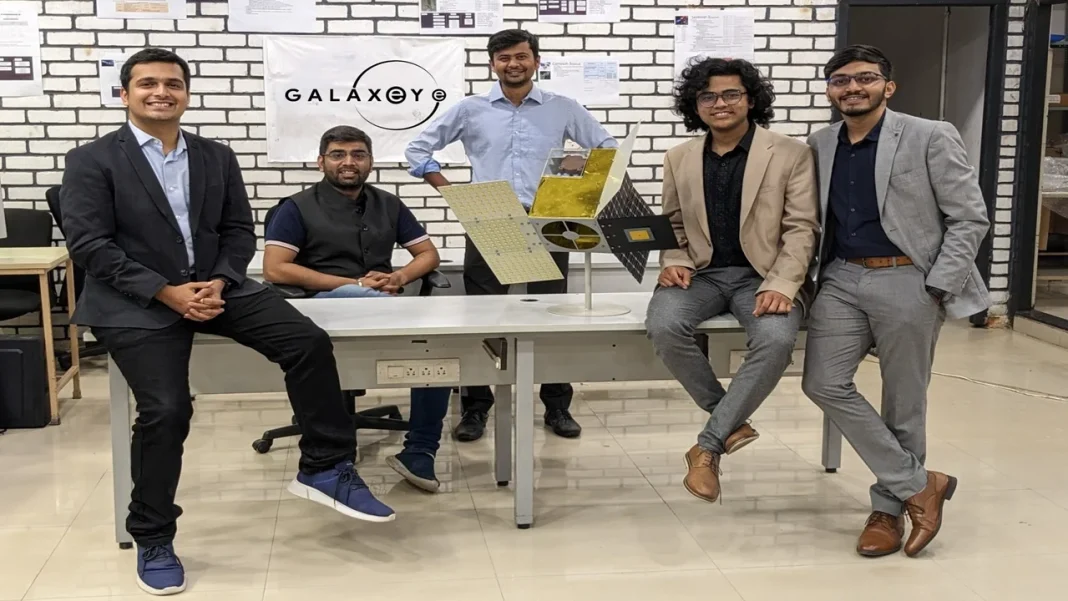

Bengaluru-based space technology startup GalaxEye has secured a US patent for the core architecture behind its OptoSAR satellite imaging system, giving the company protection for technology that synchronises optical and microwave radar sensors on one platform. The US Patent No. 12,516,926 was granted on January 6, 2026, after an application filed in May 2022. GalaxEye announced the milestone this week, calling itself the first Indian startup to receive a US patent specifically for satellite imaging technology.
The attraction is easy to see. Optical cameras can produce familiar, detailed pictures but clouds, smoke and darkness can block their view. Synthetic Aperture Radar, or SAR, sends microwave signals and can collect information at night and through cloud cover. GalaxEye’s approach tries to capture both streams over the same place at the same time, so analysts are not forced to stitch together mismatched observations from separate satellites.
Key Highlights
- GalaxEye has received US Patent No. 12,516,926 for its dual-sensor satellite imaging architecture.
- OptoSAR combines optical imagery with SAR data captured during the same satellite pass.
- Mission Drishti launched on May 3, 2026, carrying both SAR and multispectral imaging sensors.
- GalaxEye plans a 30-satellite constellation over five years for defence, agriculture and commercial customers.
What Exactly Has GalaxEye Patented?
The US patent covers a system and method for sensing a planet’s surface using sensors that are aligned and synchronised aboard a moving vehicle such as a satellite. Patent records describe spatially and temporally matched datasets that can then be processed for pixel-level co-registration. In simpler terms, GalaxEye is protecting the way two different sensors are made to look at the same patch of Earth together.
That is important because traditional optical and radar imagery may be collected at different times, from different angles or even by separate spacecraft. A road, flood boundary, ship or crop field can change between passes. GalaxEye’s single-platform design aims to reduce those gaps. The company says the same foundational invention has already received patent protection in India.
GalaxEye was founded in 2021 by engineers from IIT Madras. Its IN-SPACe company profile describes its focus on miniaturised multi-sensor SAR and electro-optical satellites, along with near real-time Earth observation data for defence and commercial uses.
Can OptoSAR Really Produce Clearer Images Through Clouds?
Not in the way a normal camera magically sees through a cloud. The optical sensor can still be blocked. The advantage comes from SAR, which uses microwave signals that can operate through clouds, haze and darkness. When radar data is collected alongside optical data in the same pass, users can still receive useful information when the visible image is partly obscured.
GalaxEye says Mission Drishti combines an X-band SAR sensor with a seven-band multispectral imager. Its mission page lists a fused spatial resolution range of about 1.2 metres to 3.6 metres, depending on the product. The company’s Chitra imagery platform also describes products combining panchromatic, RGB or multispectral information with SAR for mapping, change detection, vegetation, water and structural analysis.
So, “clearer through clouds” needs a small qualification. OptoSAR does not remove every cloud from an optical photograph. It adds radar observations that can reveal ground features even when the camera channel struggles, then aligns both datasets for analysis.
Mission Drishti Faced A Setback, But The Expansion Plan Continues
Mission Drishti, GalaxEye’s first OptoSAR satellite, launched aboard a SpaceX Falcon 9 mission from California on May 3, 2026. A Prime Minister’s Office release described it at launch as the world’s first OptoSAR satellite and India’s largest privately built satellite.
The mission later hit trouble. In July, GalaxEye said it lost communication with Drishti after an anomaly linked to radiation effects associated with a geomagnetic solar storm. The startup said key spacecraft systems and early-orbit operations had already been validated before contact was lost.
That setback has not stopped the company’s next phase. Reuters reported that GalaxEye has raised about $21 million and wants to deploy 30 satellites over the next five years. In August, it also acquired Bengaluru spacecraft engineering company StarOps, adding satellite platforms and experienced systems engineers to its in-house capabilities.
GalaxEye’s patent announcement posted on September 8, 2026. The company said the invention was conceived and engineered in India before being taken to orbit through Mission Drishti.
More Stories Worth Exploring
What Could 6G Change For India?
Check out how India’s global 6G partnership could shape the future of mobile connectivity.
Could Apple’s Foldable Cost $2,000?
Find out what fresh leaks suggest about Apple’s foldable iPhone pricing in India.
Can GPT-6 Astra Complete Tasks?
Uncover how OpenAI’s latest AI model could move beyond answering questions to handling entire tasks.
Can WhatsApp Handle Your Utility Bills?
Browse how WhatsApp’s new bill-payment feature could simplify everyday utility payments in India.
How Will EOS-05 Track Disasters?
Dive into how ISRO’s imaging satellite could help monitor cyclones, floods and forest fires.
Why This US Patent Could Strengthen India’s Private Space Push
A US patent does not guarantee commercial success, but it can help GalaxEye protect a core architecture while pitching international customers, investors and partners. Earth observation demand is rising across defence, disaster response, agriculture, insurance, maritime surveillance and infrastructure monitoring, areas where dependable imaging schedules can be valuable.
The timing also fits India’s larger private-space expansion. Reuters says the country is targeting a space economy of about $44 billion by 2033. GalaxEye now sits alongside Indian firms working on rockets, hyperspectral imaging, orbital surveillance and satellite services, but its pitch is different: combine two established sensing methods on the same spacecraft and deliver inherently aligned data.
For customers, the next test is not the patent itself. It is whether GalaxEye can turn OptoSAR into a reliable constellation, recover quickly from Mission Drishti’s setback and deliver repeated imagery at useful resolution and speed.
FAQs
What Is GalaxEye’s OptoSAR Technology?
It combines optical and radar sensors to collect aligned Earth imagery during one satellite pass.
Can GalaxEye Satellites See Through Clouds?
Its SAR sensor can observe through clouds, while optical imagery may still be partly blocked.
When Was Mission Drishti Launched?
Mission Drishti launched on May 3, 2026, aboard a SpaceX Falcon 9 mission from California.
How Many Satellites Does GalaxEye Plan To Build?
GalaxEye plans a constellation of 30 satellites over five years for global Earth observation services.
Why Is The US Patent Important For GalaxEye?
It protects GalaxEye’s core imaging architecture as the startup targets customers and partnerships beyond India.