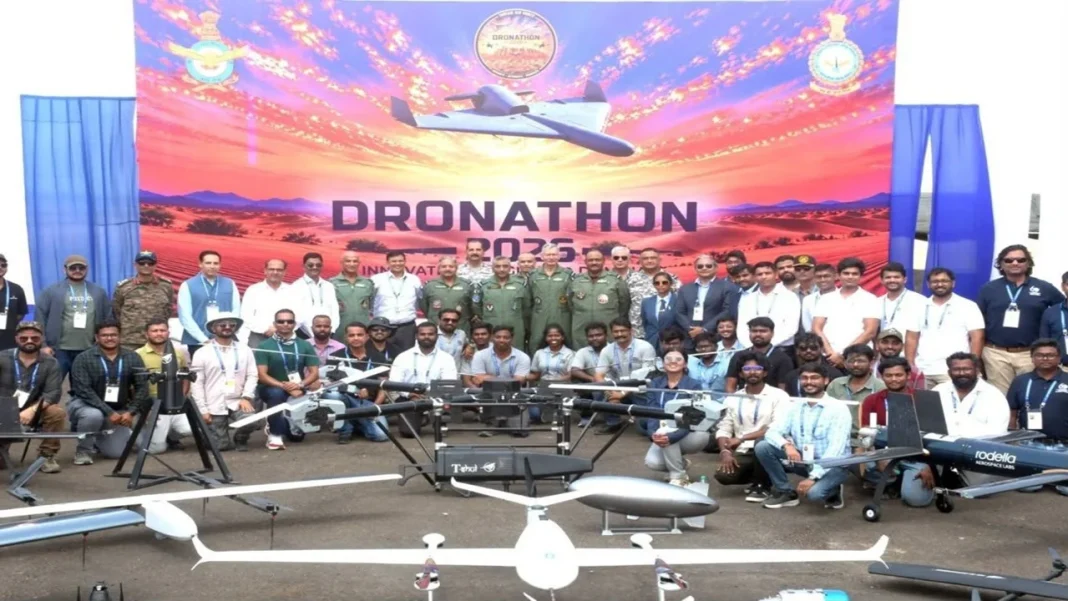

India’s first IAF Dronathon-2026 has turned the Pokhran Field Firing Range in Rajasthan into a live test bed for home-grown drone warfare. The three-day event, running from September 14 to 16, puts unmanned aircraft, counter-drone tools, swarm technology and electronic-warfare systems in front of operational users rather than exhibition visitors.
More than 60 companies accepted the Air Force’s outreach invitation, although the opening release described over 20 leading companies, start-ups, MSMEs, DPSUs and innovators taking part. The bigger question now is not which drone looks impressive, but which one keeps working when communications fail, targets move and hostile jamming begins.
Key Highlights
- Dronathon-2026 is being held at Pokhran from September 14 to 16.
- The IAF is testing surveillance, autonomous, swarm, electronic-warfare and counter-UAS technologies.
- Vayu UTtaM, an indigenous unmanned traffic management system, tracked military and civil drones in real time.
- The IAF also released a UAS Roadmap to signal future capability priorities to Indian industry.
What Dronathon-2026 Is Testing at Pokhran
The Ministry of Defence’s official Dronathon-2026 announcement says the programme combines static displays with live demonstrations to judge operational and combat effectiveness. Pokhran gives developers heat, dust, range space and an environment far closer to military use than a trade-show floor.
The IAF wants more than airframes. It is examining the full unmanned ecosystem, including propulsion, sensors, payloads, communications, autonomy, electronic warfare, countermeasures and airspace management. DD India’s report from the opening day says systems are being checked for reliability, performance in contested conditions and their ability to adapt as threats change.
That distinction is important. A drone may fly perfectly in clear radio conditions but become useless after navigation spoofing, data-link jamming or loss of satellite positioning. Modern combat rewards systems that can still navigate, identify targets and complete missions when the electromagnetic environment becomes hostile.
Which Home-Grown Systems Look Most Relevant to Combat
Public reporting from the opening day has named one system clearly: Vayu UTtaM. The indigenous multi-mode unmanned traffic management platform detected and tracked both military and civil UAS during a real-time Pokhran demonstration. It is designed to help coordinate crowded drone airspace while spotting unauthorised or rogue aircraft.
The Indian Air Force’s official X post from Pokhran also highlighted Vayu UTtaM. That makes it one of the first publicly identified technologies to emerge from the event with a demonstrated operational function.
Beyond that, reports describe categories rather than a complete model-by-model scorecard. The most important contenders include surveillance drones that can stay airborne for long periods, one-way attack drones for precision strikes, autonomous systems that need less operator input, swarms able to coordinate multiple aircraft, and counter-UAS systems built to detect, track, jam or intercept hostile drones.
The likely winners will be systems that combine low cost with repeatable performance. A sophisticated platform becomes difficult to scale if it depends on imported parts, scarce sensors or expensive launch equipment.
Why Electronic Warfare Could Decide the Winners
Ukraine, West Asia and recent India-Pakistan operations have pushed electronic warfare to the centre of drone design. The IAF’s own focus on contested environments shows that endurance alone no longer defines a useful UAV.
A battlefield-ready Indian drone needs protected communications, alternatives when satellite navigation becomes unreliable, useful autonomy after link loss and software that can handle rapidly changing routes or targets. Counter-drone systems face the reverse challenge. They must find small aircraft quickly and stop them without wasting costly missiles on every threat.
Dronathon also follows lessons from Operation Sindoor, when unmanned and counter-unmanned systems drew fresh attention across India’s defence establishment. That helps explain why Pokhran is testing attack and defence together instead of treating drones as a stand-alone category.
What Pokhran Could Decide for India’s Drone Force
Dronathon-2026 is not a procurement announcement, and the IAF has not declared a winner. Its value lies in exposing promising technology to operational scrutiny early. The new IAF UAS Roadmap should also give companies a clearer picture of what the service wants next, reducing the gap between a clever prototype and a deployable military system.
Pokhran may therefore produce fewer headlines about individual brands than some companies would like. That is probably useful. The systems worth watching are the ones that survive jamming, dust, repeated sorties and changing mission demands, then remain affordable enough for large-scale induction.
FAQs
What is Dronathon-2026?
It is the IAF’s Pokhran event for testing indigenous drones, counter-drone systems and supporting technologies.
When is Dronathon-2026 being held?
The three-day event runs from September 14 to September 16, 2026, at Pokhran, Rajasthan, India.
How many companies joined the Pokhran drone event?
More than 60 accepted the outreach invitation, while the opening release highlighted over 20 participants.
What is Vayu UTtaM?
It is an indigenous IAF system that manages traffic and detects authorised and rogue UAS.
What will decide whether a drone is combat-ready?
Reliability, anti-jamming performance, autonomy, scalable production and useful payloads will shape its military value today.
Key Stories Shaping India Today
Could US Tariffs Hit Indian Pharma?
Check out how higher US tariffs could affect Indian drug companies.
Will Visa-Free Uzbekistan Boost Indian Tourism?
Find out how easier entry could reshape tourism and business travel.
How Is India Tracking Missing Pilgrims?
Uncover how Indian authorities are tracing missing tourists and pilgrims.
What Could India’s Space Future Look Like?
Dive into the missions, ideas, and technologies discussed at the conclave.
Can Amazon Sell Indian Products Directly?
Explore how new foreign investment rules could change online retail.