

India’s NavIC programme is entering a crucial rebuilding phase. The country is preparing to launch more second-generation NVS-series navigation satellites because the older constellation has lost several spacecraft to age or technical limitations, leaving only three satellites currently providing positioning, navigation and timing services. A minimum of four operational satellites is required for standalone positioning.
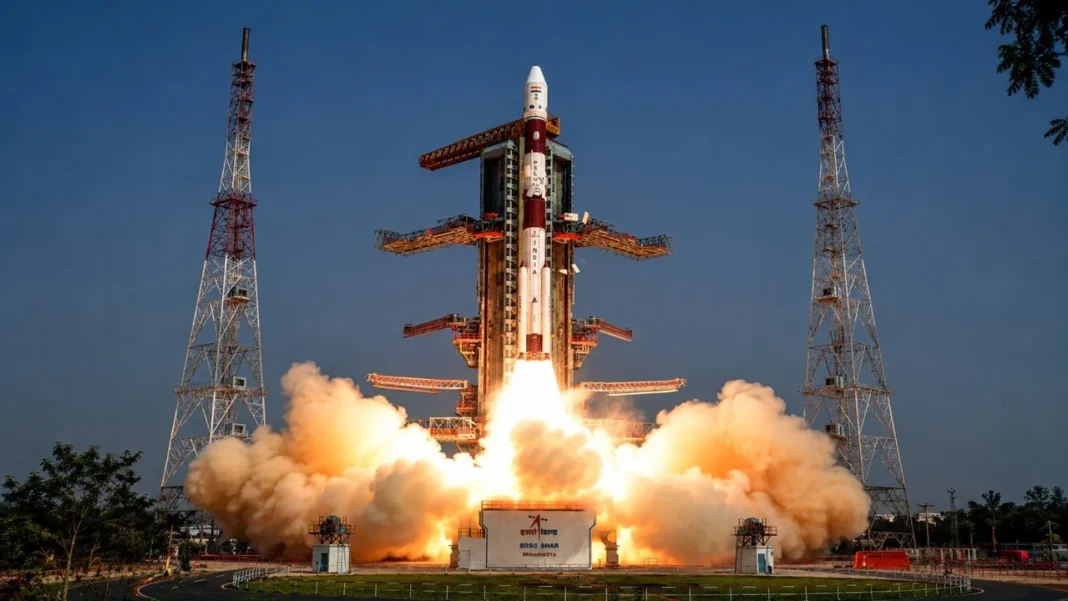
That makes the upcoming NVS-03 mission far more than a routine replacement launch. NVS-03 is ready for flight, while NVS-04 and NVS-05 are in advanced stages of realisation. Current reporting places the NVS-03 launch window between 15 and 20 October 2026, although ISRO has not yet issued a final launch time.
Key Highlights
- NavIC currently has three satellites providing PNT services, below the four needed for standalone positioning.
- NVS-03 is ready for launch, with NVS-04 and NVS-05 also moving through development.
- The NVS generation adds the L1 civilian signal alongside L5 and S-band services.
- The new satellites are designed to improve continuity, compatibility and wider device adoption.
Why India Is Moving to the NVS-Series Now
NavIC was built as India’s independent regional navigation system, covering the country and an area extending roughly 1,500 km beyond its borders. Its Standard Positioning Service is intended for civilian users, while a Restricted Service is available for authorised users. ISRO says its SPS is designed for position accuracy better than 20 metres over the primary service area.
The immediate challenge is constellation strength. In the July 2026 Lok Sabha reply on NavIC’s operational status, the government said IRNSS-1B, IRNSS-1I and NVS-01 were the three satellites then available for PNT services. IRNSS-1F had completed its 10-year mission life. With fewer than four operational spacecraft, standalone NavIC positioning is not currently available, though timing service remains functional.
The second-generation programme is meant to restore and then sustain that base layer. ISRO planned five NVS satellites, from NVS-01 to NVS-05, to replace or augment older spacecraft and improve service continuity.
NVS-01, launched in May 2023, began that transition. NVS-02 followed in January 2025, but it could not be moved from its transfer orbit to the intended operational orbit after the oxidiser-line pyro valve did not receive the required drive signal. ISRO’s 2026 review traced the problem to a likely connector-contact issue and introduced corrective actions for later missions.
What NVS-03 and the New Satellites Add to NavIC
The NVS generation carries navigation payloads in L1, L5 and S bands. The addition of L1 is especially important because it is widely used by consumer navigation hardware and can make NavIC easier to support in phones, automotive systems and Internet of Things devices.
Why the L1 Signal Could Change Everyday NavIC Use
ISRO has said the L1 signal was introduced to improve interoperability and compatibility with other global navigation satellite systems. Qualcomm and ISRO have already worked on selected chipsets that support NavIC L1, creating a clearer path for the signal to appear in mass-market devices.
The newer spacecraft also carry improved timing technology. NVS-01 flew an indigenous atomic clock for the first time in the series. Highly stable onboard clocks are central to satellite navigation because positioning depends on extremely precise signal timing.
For readers following the programme directly, ISRO’s official NVS-02 launch post on X captured the successful GSLV-F15 launch in January 2025. The post remains useful background for the NVS series even though NVS-02 later faced its orbit-raising problem.
Where a Stronger NavIC Network Could Make a Difference
A restored constellation could strengthen both public infrastructure and commercial services. Government material lists NavIC applications including vehicle tracking, real-time train tracking, fishing-vessel communication, timing support and location-based services. Recent PIB’s NavIC factsheet also points to use in power-grid synchronisation and Aadhaar geo-tagging.
The attraction is not simply having another navigation option on a phone. An Indian-controlled PNT system gives domestic users an additional regional source of positioning and timing signals, while multi-constellation receivers can combine NavIC with systems such as GPS or Galileo. The government has also said the Armed Forces currently use multi-constellation GNSS, including NavIC.
For transport and logistics, stronger satellite availability can improve the resilience of tracking systems. For fishing communities, NavIC-supported services can carry maritime boundary alerts, weather-related warnings and fishing-zone information. For telecom, finance and power networks, precise timing can be just as valuable as map positioning.
The next few launches will therefore be closely watched. NVS-03 could restore the minimum satellite count needed for standalone positioning if it enters service successfully, while NVS-04 and NVS-05 would add further redundancy. The larger goal is a NavIC network that does not depend on a small number of aging spacecraft.
FAQs
What is NVS-03?
NVS-03 is the third second-generation navigation satellite planned to strengthen India’s NavIC constellation in orbit.
When is NVS-03 expected to launch?
Current reports place launch between 15–20 October 2026, pending ISRO’s final official schedule confirmation.
What is new in the NVS series?
NVS satellites add L1 signals, updated payloads and improved timing technology for broader device compatibility.
India’s Next Space Missions Explained
Why Does NVS-03 Matter For NavIC?
Check out how NVS-03 could strengthen India’s navigation system.
What Will EOS-05 Actually Observe?
Find out how EOS-05 supports India’s Earth-observation capabilities.
When Will NVS-03 Finally Launch?
Uncover the expected launch timeline and what comes next for NavIC.
Why Is ISRO Resuming Launches Now?
Browse the reasons behind ISRO’s return to its launch schedule.
Why Is GISAT-1A Mission Important?
Dive into the mission’s significance following the PSLV-C62 setback.