

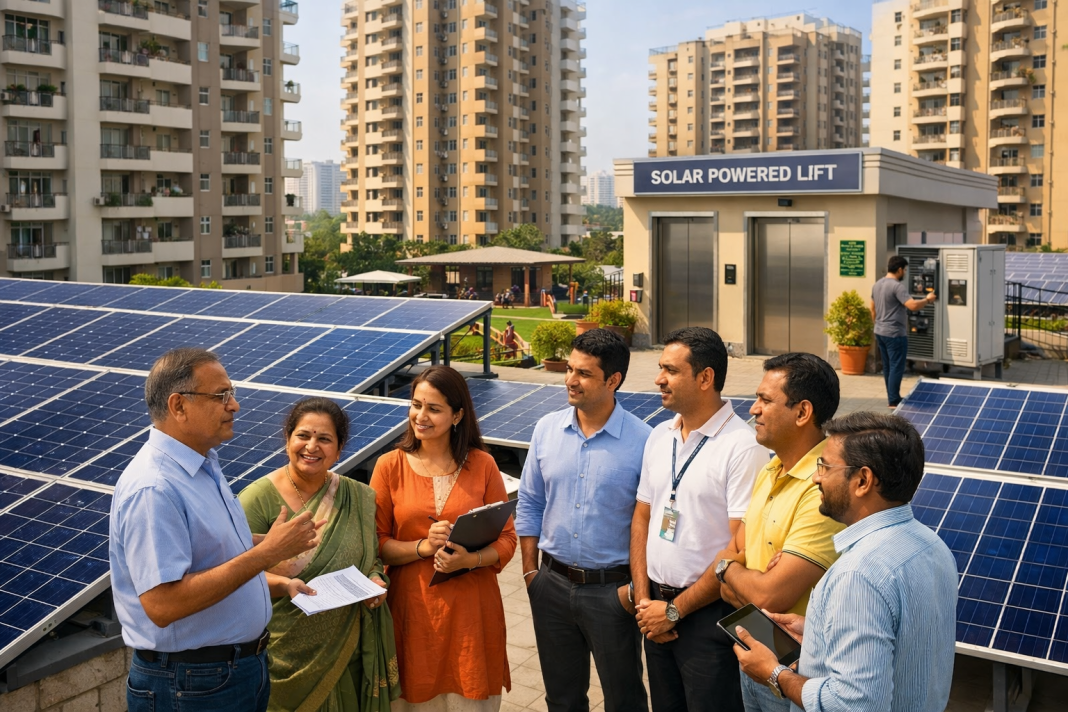

Apartment living no longer has to block solar savings. In many cities, flat owners do not control an individual rooftop, but that does not mean a housing society is out of options. Under India’s rooftop solar push, RWAs and group housing societies can use common area roofs for solar systems that power lifts, water pumps, corridor lights, security rooms, and even EV charging setups. That makes the idea far more useful for apartments where private roof ownership is missing.
This shift is getting more attention because power bills for common services have risen in many urban pockets, while solar policy has become easier to navigate. For residents, the appeal is simple: lower monthly maintenance pressure, better use of idle terrace space, and a greener image for the society. PIB India X post on PM Surya Ghar progress.
Why Apartment Residents Without Personal Rooftops Are Looking At Common Area Solar
Most apartment owners cannot install a private system because the terrace belongs to the society, not one flat. In older buildings, rooftop access is shared. In newer towers, space is crowded with tanks, telecom units, or service blocks. That is exactly why common area solar is becoming a practical route.
Instead of dividing the roof among individual homes, the RWA can install one larger system and connect it to the society meter or common facilities meter. The power can offset daytime demand from shared infrastructure. In buildings with heavy water pumping, elevators, basement ventilation, and clubhouse usage, this can create visible savings over time.
Here is where RWAs usually gain first:
- Lower common area electricity bills
- Less pressure to increase monthly maintenance
- Better use of unused terrace space
- Cleaner power for pumps, lifts, and lighting
- Extra support for shared EV charging plans
- Stronger green profile for the property
How The RWA Solar Model Works Under Current Rules
The central policy now gives a clearer route for group housing societies and RWAs. For common facilities, they can install rooftop solar systems up to 500 kWp, with central financial assistance available per kW within the notified cap. That is important because many apartment projects have enough collective load to justify a meaningful system size.
The usual process starts with checking the sanctioned load, terrace area, shadow-free zones, and the current common meter pattern. After that, the RWA can seek quotes from empanelled vendors, estimate annual generation, and compare that against the society’s common consumption. Once the numbers look workable, the project can move through approvals, vendor selection, and installation.
Where Savings Usually Show Up First
In most apartment complexes, the first savings come from water pumps, lift operations, staircase and corridor lighting, guard rooms, CCTV systems, and club facilities. If the society has daytime demand, solar usage becomes more efficient because generated power is consumed where it is produced.
What Makes Common Area Solar A Good Fit For RWAs Right Now
The timing looks stronger now than it did a few years ago. Rooftop solar has become more mainstream, official portals have made application pathways easier, and public policy keeps pushing distributed clean energy. That broader momentum helps apartment societies because vendors, discoms, and residents are now more familiar with rooftop projects.
Another advantage is financial planning. A society does not always need to depend on a one-time lump sum from residents. Some RWAs evaluate phased contribution models, maintenance fund support, or installer-led financing structures. When savings begin to show on common bills, resident approval also becomes easier for future upgrades such as battery backup or EV charging.
What RWAs Should Check Before Signing A Solar Deal
The biggest mistake is treating solar as only a vendor decision. It is an operations and governance decision, too. The RWA should first check structural safety, shadow analysis, meter alignment, vendor credentials, warranty terms, annual maintenance support, and the state discom’s net metering or billing rules.
Societies should also keep resident communication simple. Show current common area bills, expected generation, payback logic, and who will handle maintenance after installation. When residents can see how solar affects lifts, pumps, and monthly dues, approval gets smoother.
A well-run project usually works best when the RWA starts with hard numbers, chooses a credible installer, and shares updates openly with residents. For apartment complexes without private rooftops, common area solar is no longer a niche idea. It is becoming one of the most workable ways to cut recurring power costs without waiting for every flat owner to act separately.
FAQS
Can an apartment owner get solar without owning the terrace?
Yes, the RWA can use shared rooftop space for common meter-based solar savings.
What can common area solar power in a housing society?
It can run lifts, pumps, lighting, CCTV systems, guard rooms, and shared EV charging.
Is there any subsidy for RWAs under PM Surya Ghar?
Yes, notified support is available for common facilities under the current group housing rules.
Does every resident need to install panels separately in apartments?
No, one shared system can offset society-level electricity use through the common area setup.
What should an RWA review before choosing a solar vendor?
Check structure, shading, warranties, maintenance terms, meter rules, and vendor track record first.