

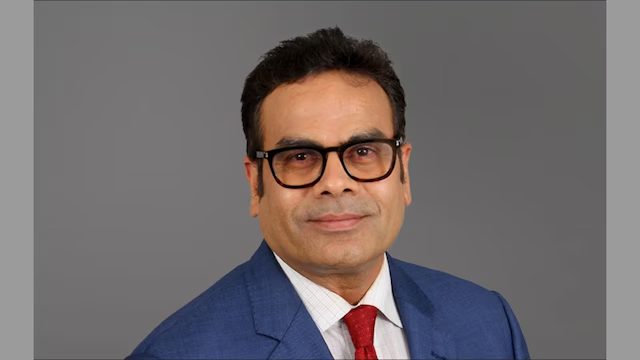

Infosys has named company veteran Ashiss Kumar Dash as its next chief executive while trimming its FY27 revenue growth outlook, putting succession and a softer demand environment in focus. Dash, who has spent more than three decades at Infosys, will become Managing Director and CEO from April 1, 2027, after Salil Parekh completes his second term on March 31.
The timing is notable. Infosys reported year-on-year growth in its June-quarter numbers, yet narrowed constant-currency revenue guidance to 1.5%-3.0% from 1.5%-3.5%. The lower end is unchanged. Management is signalling caution over client technology budgets, slower discretionary spending and a macro recovery that has not arrived as strongly as expected.
Key Highlights
- Ashiss Kumar Dash will become Infosys MD and CEO from April 1, 2027, subject to approvals.
- Salil Parekh will remain CEO until March 31, 2027, and support the leadership handover.
- FY27 constant-currency revenue guidance is now 1.5%-3.0%, down from 1.5%-3.5%.
- Q1 revenue reached $5.082 billion, while operating margin stood at 21.1%.
- AI services contributed 8.2% of revenue, and large deal wins were worth $3.6 billion.
Who Is Ashiss Kumar Dash And Why Did Infosys Choose Him?
Dash is an internal choice with deep operating experience. He currently serves as Executive Vice President and Global Head for Services, Utilities, Resources, Energy and Enterprise Sustainability. His career has covered delivery, client-facing roles, operations and business leadership across geographies.
Chairman Nandan Nilekani has highlighted Dash’s exposure to sales, account management and delivery. The appointment gives Infosys a leader who already knows its clients and delivery structure while the industry is being reshaped by generative AI, automation and new pricing models. Dash’s proposed CEO term is five years, subject to shareholder and statutory approvals.
Parekh, who has led Infosys since 2018, will remain in charge through March and is expected to work closely with Dash during the transition. His tenure took Infosys from about $10 billion in annual revenue to more than $20 billion, with cloud, digital services and AI becoming major growth areas.
The Hindu also posted the leadership announcement on its official X account on July 23, giving the succession decision wider social-media visibility.
Why Did Infosys Cut Its FY27 Growth Forecast?
The guidance cut does not imply shrinking revenue. Infosys still expects growth, but sees less room at the top end. Its FY27 constant-currency forecast moved from 1.5%-3.5% to 1.5%-3.0%, while operating margin guidance stayed at 20%-22%.
Parekh said the earlier upper end assumed a stronger macroeconomic environment. That recovery has not fully appeared. Global companies remain selective on technology spending, especially projects that can be postponed. Cost reduction, vendor consolidation and AI-led productivity work are receiving budgets, while discretionary transformation spending remains patchier.
Investors reacted quickly. Infosys’ US-listed shares fell about 5% in early trading after the announcement, Reuters reported. Quarterly revenue and net profit also came slightly below analyst estimates compiled by LSEG, adding to the cautious mood.
What Do Infosys Q1 Numbers Reveal About Its AI Shift?
Infosys reported $5.082 billion in revenue, up 2.4% year on year and 1.0% sequentially in constant currency. Operating margin was 21.1%. Free cash flow reached $955 million, while large deal total contract value was $3.6 billion, with 61% net new.
The standout number was AI. Infosys said AI services represented 8.2% of quarterly revenue, up from 5.5% in the December quarter. That indicates more enterprise AI work is moving from pilots into paid programmes. Recent collaborations with OpenAI, GlobalFoundries and Sentara also show where Infosys is placing its next growth bets.
Yet AI cuts both ways for Indian IT firms. It can create consulting, engineering and modernisation work, but it can also reduce labour needed on existing contracts. Clients may demand a share of productivity savings. That helps explain why stronger AI revenue can sit alongside conservative full-year guidance.
What Happens Next For Infosys, Investors And Employees?
The next few quarters will test two stories. Infosys must show that AI work, large deals and vendor consolidation can offset weak discretionary spending. Dash must also prepare to take charge without distracting the company during a long transition.
A workforce shift is emerging too. Infosys plans to build a pool of 6,000 forward-deployed engineers working closer to client teams, while continuing fresher hiring. That points to a model where engineers are placed nearer to business problems instead of relying only on conventional offshore delivery.
For investors, the checkpoints are whether large deals convert into revenue faster, AI’s revenue share keeps rising and the 1.5%-3.0% guidance range holds. The CEO choice offers continuity. The forecast cut shows the demand pressure around global IT services has not disappeared.
FAQs
When Will Ashiss Kumar Dash Become Infosys CEO?
Ashiss Kumar Dash will become MD and CEO on April 1, 2027, subject to approvals.
Who Will Ashiss Kumar Dash Replace At Infosys?
He will replace Salil Parekh, whose second term as CEO ends on March 31, 2027.
What Is Infosys’ New FY27 Revenue Guidance?
Infosys now expects constant-currency revenue growth of 1.5% to 3.0% for the full financial year.
How Much Revenue Did Infosys Generate In Q1 FY27?
Infosys reported quarterly revenue of $5.082 billion, with constant-currency growth of 2.4% year on year.
How Important Is AI Revenue For Infosys Now?
AI services contributed 8.2% of Infosys revenue in Q1, showing commercial adoption across enterprise clients.