
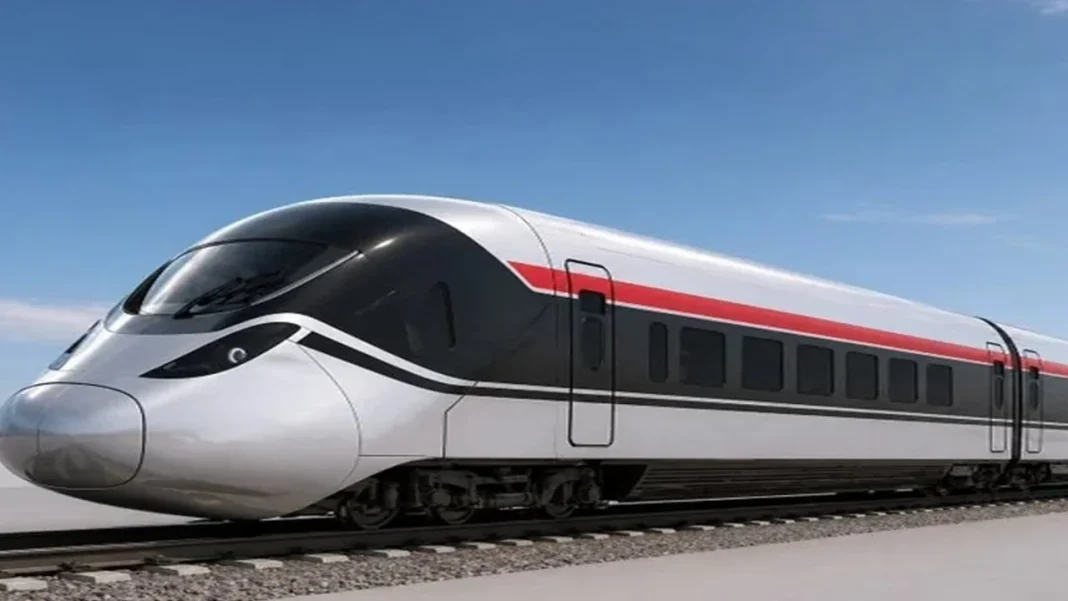

India’s first Made-in-India bullet train, B28, is being manufactured at BEML’s Aditya facility in Bengaluru for the Mumbai-Ahmedabad high-speed rail corridor. Railway Minister Ashwini Vaishnaw reviewed its manufacturing on 1 November 2026, including a structural test of the train body.
The latest Ministry of Railways fact sheet lists a 280 km/h maximum test speed and 249 km/h operational speed. The train remains under development. Manufacturing progress should not be read as the start of passenger services.
Key Highlights
- BEML is building the indigenous B28 trainset in Bengaluru.
- The Mumbai-Ahmedabad corridor covers approximately 508 km with 12 planned stations.
- The latest train specifications separate 280 km/h test speed from 249 km/h operation.
- The initial Surat-Vapi service is targeted for August 2027, subject to readiness.
Made-in-India Bullet Train Manufacturing Reaches Testing Stage
During the Bengaluru visit, Vaishnaw witnessed a squeeze test, in which controlled compression and tension are applied to the car body to assess structural strength and stability.
That is a manufacturing check, rather than evidence that the train has completed high-speed track trials. Readers can watch the minister’s 1 November manufacturing update on X, showing the work at BEML.
The project began with an October 2024 order from Integral Coach Factory for two eight-car high-speed trainsets. BEML’s original announcement targeted delivery by the end of 2026. The minister’s latest update, reported by Akashvani, says the prototype may roll out early in 2027.
A prototype rollout, track testing and commercial clearance are separate milestones. The revised expectation should therefore be treated as a manufacturing target, not a ticket-booking date.
Mumbai-Ahmedabad Bullet Train Route and Stations
The Railway Ministry’s corridor update identifies a 508-km route through Maharashtra, Gujarat and Dadra and Nagar Haveli.
Its 12 planned stations are:
- Maharashtra: Mumbai, Thane, Virar and Boisar.
- Gujarat: Vapi, Billimora, Surat, Bharuch, Vadodara, Anand, Ahmedabad and Sabarmati.
The proposed first service covers the 97-km Surat-Vapi section, rather than the entire Mumbai-Ahmedabad journey. Opening that stretch would introduce high-speed travel within part of Gujarat; it would not yet provide an end-to-end connection from Mumbai.
Passengers should distinguish a corridor announcement from the section actually being commissioned. Route length alone does not show how much railway is ready for operation.
B28 Speed and Technology Explained
Several speed figures describe different parts of the project.
| Specification | Published Speed | What It Refers To |
| B28 maximum test speed | 280 km/h | Train testing specification |
| B28 operational speed | 249 km/h | Latest published train operating specification |
| Corridor operational specification | 320 km/h | Capability planned for the high-speed railway |
The first two figures come from the Railway Ministry’s 1 November fact sheet. The corridor figure appears in the government’s high-speed rail backgrounder.
B28’s design includes regenerative braking to recover energy during braking. Computer simulations have been used to refine airflow around the nose and body, including the effects of tunnel pressure waves.
Passenger features include level boarding, wheelchair-accessible doors, and emergency talk-back units. Wi-Fi-based infotainment is described as access to preloaded content, which should not be confused with a promise of unrestricted onboard internet.
Project Progress and the August 2027 Launch Target
Progress extends beyond building the train. Dated infrastructure updates show work on the railway’s other systems:
- Tunnelling: NHSRCL reported TBM assembly at Vikhroli for the 16-km machine-bored portion of the Mumbai tunnel.
- Electrification: A July 2026 electrification update detailed the corridor’s 2×25 kV overhead traction system.
The full Mumbai tunnel is 21 km long, including a 7-km undersea section beneath Thane Creek. Those figures describe the tunnel’s scope, not completed excavation.
The government’s July backgrounder targets August 2027 for the first Surat-Vapi service. Successful operation still requires the train, track and supporting systems to be ready together.
Follow NHSRCL’s official updates and India Focus Daily for verified trial, opening, and passenger-service announcements.
FAQs
Is India’s Made-in-India bullet train carrying passengers?
No. The November 2026 updates describe manufacturing and testing activity. A prototype rollout does not establish that passenger services have started or commercial clearance has been granted.
How fast is the B28 expected to run?
The Railway Ministry’s latest fact sheet lists 249 km/h for operation and 280 km/h for testing. Neither figure should be confused with the corridor’s 320 km/h specification.
Who is manufacturing the indigenous bullet train?
BEML is manufacturing the trainsets in Bengaluru under an Integral Coach Factory order. The original contract covers two high-speed trainsets, each consisting of eight passenger cars.
Will the first service connect Mumbai and Ahmedabad directly?
The announced initial service targets Surat-Vapi, a 97-km section within the larger corridor. That opening would not establish passenger operations across the full Mumbai-Ahmedabad route.
Does tunnel construction progress mean the line is ready?
No. Tunnel and viaduct work are infrastructure stages. Track, power supply, and other systems must also be ready, alongside train testing and clearance for passenger operations.
Explore More Railway Breakthroughs and India’s Biggest Train Updates!
1. How fast will India’s trains go?
Explore India’s first high-speed rail test track in Rajasthan and the speeds planned for testing.
2. Why is the bullet train budget rising?
3. What makes this freight train special?
4. Can Kavach 4 make trains safer?
5. Why did Karnataka ban college reels?